
Table of Contents
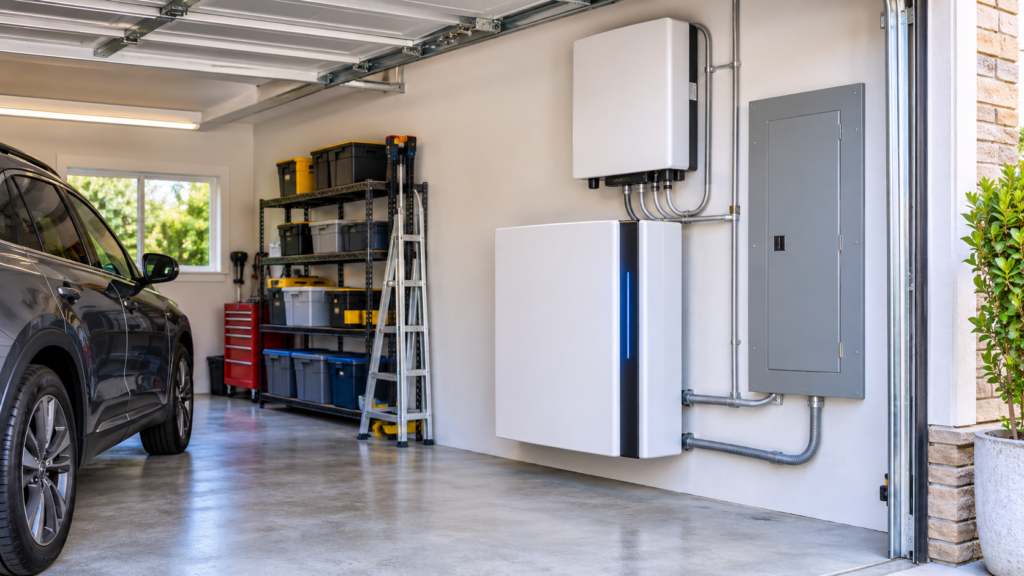
Yes, you can install a battery backup system in a garage, provided the location meets the battery manufacturer’s installation requirements, local electrical codes, and applicable fire-safety regulations. For homeowners in Los Angeles and Southern California, a garage can be a practical location for a home battery because it may offer convenient access to electrical equipment while keeping the system out of the main living area.
However, not every garage is suitable. Available space, temperature conditions, ventilation requirements, wall construction, electrical panel capacity, and battery placement must all be evaluated before installation.
If you’re considering adding backup power to your home, here’s what you should know before installing a battery backup system in your garage.
Why Install a Battery Backup System in a Garage?
A garage can provide a convenient location for a residential energy storage system. Many homeowners already have electrical equipment, utility connections, or solar-related components in this area.
Some potential advantages include:
- Convenient electrical access: Depending on the home’s layout, the garage may provide a practical route to the main electrical panel.
- Keeps equipment outside living spaces: A properly designed installation can avoid occupying indoor living areas.
- Accessible for maintenance: The system can be positioned where qualified technicians can inspect and service it.
- Integration with solar: A compatible battery system can work with an existing or new solar installation.
- Backup power availability: Stored energy can help power selected household circuits during an outage.
The actual benefits depend on the home’s electrical configuration and the battery equipment selected.
7 Important Things to Check Before Garage Battery Installation
1. Garage Temperature and Environmental Conditions
Temperature is one of the most important factors when choosing a battery installation location.
Battery manufacturers specify permitted operating and storage temperature ranges. A garage that becomes extremely hot during Southern California summers may require additional consideration.
High temperatures can affect battery performance, lifespan, and charging behavior. Some systems include temperature monitoring and thermal management features, but these do not eliminate the need to follow manufacturer installation requirements.
Before installation, evaluate:
- Typical summer garage temperatures
- Exposure to direct sunlight
- Proximity to heat-producing equipment
- Manufacturer temperature specifications
- Required environmental clearances
2. Available Wall and Floor Space
A battery backup system needs sufficient space for the equipment and its required clearances.
Depending on the model, the installation may include a battery unit, inverter, backup gateway, disconnects, and other electrical components.
The installer should evaluate:
- Available wall space
- Wall construction and structural support
- Required service clearances
- Distance from doors and windows
- Access to electrical equipment
- Protection from accidental impact
Do not assume that an empty garage wall automatically qualifies as an acceptable installation location.
3. Fire Safety and Local Electrical Requirements
Battery installation must follow applicable electrical codes, fire-safety requirements, manufacturer instructions, and local permitting rules.
Lithium-ion battery systems require particular attention to their installation environment and protection requirements.
The installation location may be subject to restrictions involving:
- Required separation distances
- Exit pathways and doorways
- Windows and other openings
- Fire-rated construction
- Equipment mounting
- Emergency access
Requirements can vary based on battery chemistry, system capacity, equipment listing, installation configuration, and local authority requirements.
A qualified contractor should verify the applicable requirements before selecting the final location.
4. Protection From Vehicles and Physical Damage
Garages are frequently used for parking, storing tools, and moving heavy equipment.
A battery system should not be installed where a vehicle, garage door mechanism, or stored object could accidentally damage it.
Depending on the manufacturer’s instructions and applicable code, additional physical protection may be necessary.
Consider the following:
- Distance from vehicle parking areas
- Protection from accidental impacts
- Safe access around the equipment
- Avoiding locations near moving garage door components
- Keeping storage items away from the battery
The system should remain accessible for inspection and emergency response.
5. Electrical Panel Compatibility
Before installing a garage battery, the contractor must evaluate the home’s existing electrical system.
The battery may need to connect to the main electrical panel, a backup gateway, a dedicated load panel, or another manufacturer-approved configuration.
Important considerations include:
- Main electrical panel capacity
- Available breaker spaces
- Existing electrical loads
- Battery inverter output
- Backup gateway compatibility
- Required disconnects and overcurrent protection
If the existing electrical panel cannot support the proposed configuration, an electrical panel upgrade or alternative design may be necessary.
6. Ventilation and Manufacturer Requirements
Not every battery system has the same ventilation requirements.
Some battery products are designed for specific indoor or outdoor installation environments, while others have restrictions concerning enclosed spaces.
Before selecting a garage location, review the product’s installation manual for:
- Approved installation environments
- Airflow and ventilation requirements
- Required clearances
- Temperature limitations
- Mounting restrictions
- Prohibited installation locations
Never assume that opening a garage window or adding a fan makes an otherwise prohibited installation acceptable.
7. Permits and Inspection
A residential battery backup installation generally requires electrical permitting and inspection under applicable local requirements.
In Los Angeles and surrounding Southern California communities, the exact permitting process depends on the project location and system configuration.
Your contractor may need to coordinate:
- Electrical permit applications
- Battery equipment documentation
- Electrical diagrams
- Utility interconnection requirements
- Inspection scheduling
- Final system approval
If the battery is being added to an existing solar system, the contractor should also review the existing solar equipment and applicable utility requirements.
Can You Install a Solar Battery in a Garage?
Yes. Many residential energy storage systems are designed for specific indoor installation environments, including qualifying garages.
A solar battery can store excess electricity generated by a compatible solar system during the day. The stored energy can then be used later, depending on the system configuration and operating settings.
However, battery compatibility is important.
Before installation, check:
- Whether the battery supports your existing solar inverter
- Whether a compatible backup gateway is required
- Whether the system supports whole-home or partial-home backup
- Whether your electrical panel needs modifications
- Whether the battery location meets manufacturer requirements
An existing solar system does not automatically mean that every battery product can be connected to it.
What Can a Garage Battery Backup System Power?
The amount of electricity available during an outage depends on battery capacity, inverter output, system configuration, and household energy consumption.
Many homeowners choose to back up essential electrical loads rather than the entire property.
Common backup loads include:
- Refrigerators and freezers
- Essential lighting
- Wi-Fi routers and networking equipment
- Selected electrical outlets
- Security systems
- Certain heating or cooling equipment
- Medical equipment where appropriately designed
Large appliances, air conditioning systems, electric ranges, and EV chargers can require substantial power. Their compatibility with backup operation must be evaluated individually.
A properly designed system should reflect the homeowner’s actual backup priorities.
Garage Battery Backup vs. Outdoor Battery Installation
Both garage and outdoor installations can be suitable, depending on the equipment and property conditions.
| Consideration | Garage Installation | Outdoor Installation |
|---|---|---|
| Weather exposure | Generally more sheltered | Exposed to outdoor conditions |
| Temperature | Can become very hot | Depends on sun exposure and climate |
| Space | Uses garage wall or floor space | Uses suitable exterior space |
| Physical protection | May need vehicle-impact protection | May need protection from weather and impact |
| Maintenance access | Depends on garage layout | Depends on exterior placement |
| Installation suitability | Manufacturer and code dependent | Manufacturer and code dependent |
There is no universal best location. The right choice depends on the battery model, property layout, installation requirements, and available electrical infrastructure.
How Much Does Garage Battery Backup Installation Cost?
The cost of installing a garage battery backup system depends on the battery capacity, electrical configuration, installation complexity, and any required upgrades.
Major cost factors include:
Battery capacity: Larger storage systems generally cost more than smaller systems.
Inverter and gateway equipment: Some installations require additional equipment to manage backup power and connect the battery to the home’s electrical system.
Electrical panel upgrades: An existing panel may require modifications or replacement.
Installation labor: Wall mounting, wiring routes, equipment placement, and system configuration affect labor costs.
Permits and inspections: Local permitting requirements and project-specific documentation contribute to the overall installation cost.
Solar integration: Connecting a battery to an existing solar system may involve additional compatibility checks and electrical work.
The most reliable way to estimate the project cost is to evaluate the home’s electrical system and determine which circuits need backup power.
Is a Garage Battery Backup System Worth It in California?
For homeowners who want greater energy resilience, a garage battery backup system may be worth considering.
A properly designed battery can provide backup electricity during utility outages, help use stored solar energy after sunset, and support selected household electrical loads.
However, the value depends on your electricity usage, outage concerns, utility rate structure, solar production, battery capacity, and installation cost.
Before purchasing a system, consider how much backup power you actually need and whether your existing electrical equipment can support the installation.
Why Choose ReVamp Energy for Battery Backup Installation?
Installing a battery backup system requires more than selecting a battery and mounting it on a wall. The electrical system, equipment compatibility, installation environment, and backup requirements all need to work together.
ReVamp Energy provides electrical and renewable energy services for residential and commercial properties throughout Los Angeles and Southern California.
Our team can help evaluate:
- Existing electrical panel capacity
- Solar and battery compatibility
- Battery placement options
- Essential backup loads
- Electrical upgrades
- Installation and permitting requirements
Whether you are adding battery storage to an existing solar system or planning a new solar and battery installation, proper system design is essential.
Ready to explore battery backup for your home? Contact ReVamp Energy to discuss your property and get your free energy consultation.
Frequently Asked Questions
Can a lithium battery be installed inside a garage?
Some lithium battery systems are approved for specific indoor garage installations. However, the exact battery model must be listed for the intended environment and installed according to its manufacturer instructions and applicable codes.
Does a garage battery backup system need ventilation?
Ventilation requirements vary by battery chemistry and product design. Always follow the manufacturer’s installation manual and applicable local requirements.
Can I install a battery backup system next to my electrical panel?
Potentially, yes. The location must meet equipment clearance, mounting, access, temperature, and applicable electrical and fire-safety requirements.
Can a garage battery power my entire house?
Some systems can support whole-home backup, while others are designed for selected circuits. The result depends on battery capacity, inverter output, household loads, and electrical configuration.
Can I add a battery to my existing solar panels?
In many cases, yes. However, compatibility with the existing inverter, electrical equipment, and utility interconnection arrangement must be evaluated before installation.
Do I need a permit to install a home battery in Los Angeles?
Battery installations generally require applicable permits and inspections. Requirements depend on the project location, equipment, and installation design. A qualified contractor should confirm the local process before work begins.