
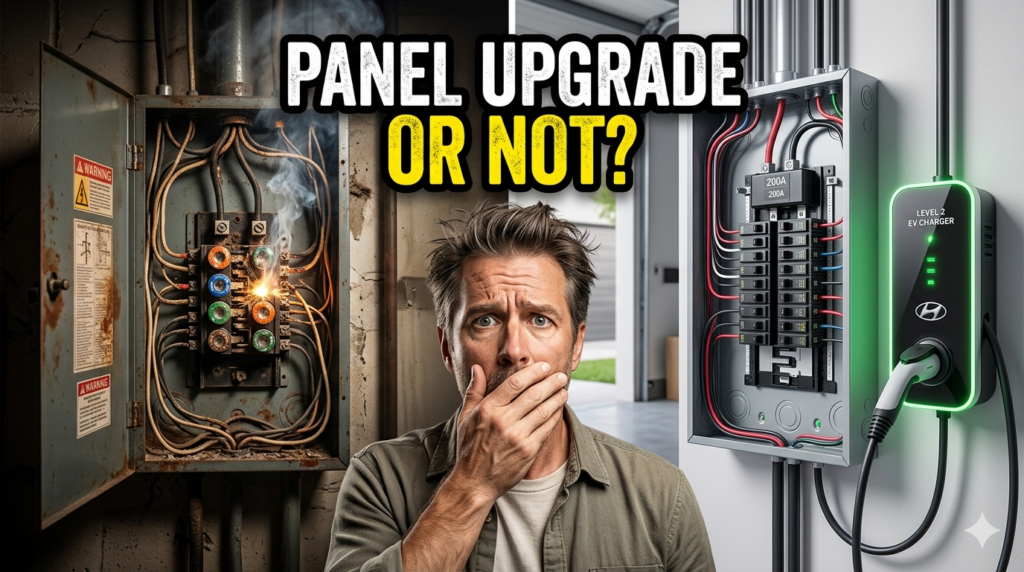
Do You Need a Panel Upgrade for EV Charging in Los Angeles?
Table of Contents
Introduction
If you’re planning to install an EV charger in Los Angeles, one of the first questions is:
Do you actually need a panel upgrade?
The answer is not always yes—but in many cases, it is required.
It depends on your home’s electrical capacity, the type of charger you choose, and how much load your system is already handling.
Let’s break it down clearly so you don’t overspend—or underprepare.
Short Answer (Quick Reality Check)
- Level 1 charger (120V) → NO upgrade needed
- Level 2 charger (240V) → SOMETIMES needed
- Older homes (100-amp panel) → VERY LIKELY needed
Why Panel Capacity Matters
Your electrical panel controls how much power your home can safely handle.
A typical Level 2 EV charger requires:
- 40–48 amps continuous load
- 50–60 amp dedicated circuit
That’s a huge addition to your existing electrical demand.
If your panel cannot handle it, you risk:
- Breaker trips
- Overheating
- Fire hazards
When You DO Need a Panel Upgrade
1. You Have a 100-Amp Panel
This is the most common case in Los Angeles.
- Most older homes = 100A service
- EV charger alone can take ~60 amps
That leaves almost no room for:
- AC
- Oven
- Dryer
- Lights
Result → Upgrade required (usually 200A)
2. Your Panel Is Already Full
Even if you have a 200-amp panel:
- No space for new breaker
- No spare capacity
Then → Upgrade OR subpanel required
3. Load Calculation Fails
Electricians perform a load calculation to check:
- Total home usage
- Future demand
- Safety margin
If total load exceeds capacity → upgrade mandatory
4. You Want Fast Charging (Level 2)
In Los Angeles:
- Level 2 chargers are standard
- Require dedicated 240V circuit
- Permit is mandatory
This alone can trigger upgrade requirements
When You DON’T Need a Panel Upgrade
1. You Have a 200-Amp Panel with Free Capacity
Many newer homes already support EV charging.
No upgrade needed—just install circuit.
2. You Use a Low-Amperage Charger
Instead of 48A:
- Use 24A or 32A charger
- Lower power demand
May fit your existing panel.
3. You Install Load Management System
Smart systems can:
- Reduce EV charging when AC runs
- Balance total load automatically
This can avoid full panel upgrade in some cases
Real Cost Impact in Los Angeles
Panel upgrade cost:
- $2,500 – $6,000+
EV charger installation:
- $1,200 – $3,000
Total project can jump significantly if upgrade is needed
Los Angeles-Specific Rules
In Los Angeles:
- Level 2 charger → permit required
- Panel upgrade → separate permit
- Inspection mandatory
Also:
- Utility (LADWP) may inspect if service is upgraded
Biggest Mistake Homeowners Make
Most people:
❌ Buy charger first
❌ Skip panel check
❌ Face surprise upgrade cost
Correct approach:
✔ Panel assessment first
✔ Load calculation
✔ Then install charger
Smart Strategy (What Pros Recommend)
Instead of guessing:
- Check panel size (100A / 150A / 200A)
- Do load calculation
- Choose charger accordingly
- Upgrade only if required
This saves thousands.
Why Homeowners Choose ReVamp Energy Solutions
At ReVamp Energy Solutions, we don’t push upgrades unless they’re actually needed.
We analyze your system and give you the smartest option:
- Upgrade only if required
- Or optimize existing panel
Our EV Charging Services
- EV charger installation
- Panel capacity evaluation
- Load calculation
- Panel upgrades (if needed)
- Smart load management systems
What Makes Us Different
- Honest recommendations (no upselling)
- Future-ready electrical planning
- Expertise in EV + solar systems
- Code-compliant installation
Conclusion
So, do you need a panel upgrade for EV charging in Los Angeles?
- Yes → if you have 100A panel or high load
- No → if you have spare capacity
- Maybe → depends on load calculation
The only real answer comes from a professional assessment.
FAQs
Do all EV chargers require panel upgrade
No, but most Level 2 setups may require it in older homes.
Is 200-amp panel enough
Usually yes for one EV charger.
Can I avoid upgrading panel
Yes, with load management or lower-power charger.
How do I know my panel size
Check the main breaker rating inside your panel.