
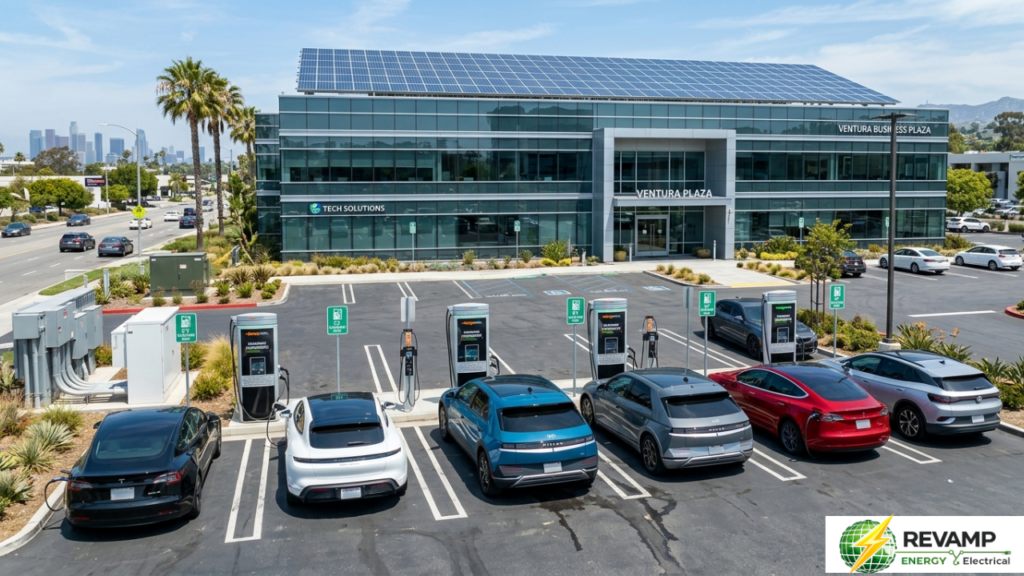
Commercial EV Charger Installation
Introduction
Electric vehicles are rapidly changing the transportation landscape across California. As more drivers switch to EVs, businesses are beginning to recognize the value of providing convenient charging options for customers, employees, tenants, and fleet vehicles.
Commercial EV charger installation is no longer viewed as a luxury amenity. For many businesses, it has become a strategic investment that helps attract visitors, support sustainability goals, and prepare properties for future demand.
Whether you operate an office building, retail center, apartment complex, hotel, warehouse, medical facility, or commercial property, understanding the requirements and benefits of EV charging infrastructure is essential before starting a project.
Installing commercial charging stations involves much more than simply purchasing chargers. Electrical capacity, site planning, future expansion, and long-term performance all play important roles in a successful installation.
This guide explains everything business owners should know before investing in commercial EV charger installation.
Why Commercial EV Charging Is Growing
The number of electric vehicles on California roads continues to increase every year.
As EV adoption grows, drivers expect charging availability wherever they work, shop, dine, or stay overnight.
Businesses that provide charging stations often gain advantages such as:
- Increased customer convenience
- Improved employee satisfaction
- Enhanced property appeal
- Modernized infrastructure
- Future-ready facilities
Many commercial property owners now view EV charging the same way they view Wi-Fi, parking, and other essential amenities.
Providing charging access demonstrates that a business is adapting to changing customer expectations and transportation trends.
Benefits of Commercial EV Charger Installation
Attract More Customers
EV drivers frequently search for businesses that offer charging facilities.
When customers can charge their vehicles while shopping, dining, or attending appointments, they are often more likely to choose that location over competing businesses.
Charging stations can encourage longer visits and create additional opportunities for customer engagement.
Improve Employee Satisfaction
Workplace charging has become an increasingly valuable employee benefit.
Employees who drive electric vehicles appreciate the convenience of charging while they work.
Offering charging access can help businesses:
- Improve employee experience
- Support sustainability initiatives
- Enhance workplace benefits
- Attract qualified candidates
Increase Property Value
Commercial properties with EV charging infrastructure are often viewed as more attractive by tenants and future occupants.
As electric transportation becomes more common, charging capabilities may become a key factor in property selection.
Support Sustainability Goals
Many businesses are actively working to reduce their environmental impact.
Commercial EV charging supports sustainability initiatives while helping organizations demonstrate commitment to cleaner transportation solutions.
Understanding Commercial EV Charger Types
Not all charging stations are designed for the same purpose.
Selecting the right charger depends on how the property will be used.
Level 2 Chargers
Level 2 chargers are among the most popular commercial solutions.
These chargers are commonly installed at:
- Office buildings
- Hotels
- Retail centers
- Multifamily communities
- Employee parking areas
Because vehicles often remain parked for several hours, Level 2 charging provides an effective balance between charging speed and installation costs.
Fleet Charging Solutions
Businesses operating company vehicles often require dedicated fleet charging infrastructure.
Fleet charging systems are designed to support multiple vehicles while optimizing charging schedules and electrical demand.
High-Power Commercial Charging
Some businesses require faster charging capabilities for customers or fleet operations.
These installations typically involve more extensive electrical infrastructure and advanced planning.
The ideal charging solution depends on property usage, customer behavior, and future growth expectations.
Why Electrical Planning Matters
One of the biggest mistakes business owners make is focusing only on the charger itself.
The charger is only one part of the overall system.
Electrical infrastructure plays a critical role in project success.
Before installation begins, several factors must be evaluated:
- Existing electrical capacity
- Available panel space
- Service size
- Future expansion plans
- Energy demand requirements
Without proper planning, businesses may face costly upgrades later.
Professional load calculations help determine whether the existing electrical system can safely support additional charging equipment.
Site Assessment Considerations
Every commercial property is unique.
A thorough site assessment helps determine the most effective charging strategy.
Factors commonly evaluated include:
Parking Layout
Charger placement should maximize accessibility while minimizing disruption to traffic flow.
Distance from Electrical Equipment
Longer electrical runs may increase installation complexity and costs.
User Accessibility
Charging stations should be convenient for customers, employees, and tenants.
Future Expansion
Many businesses begin with a small number of chargers but later expand as demand grows.
Planning for expansion from the beginning often reduces future installation costs.
Understanding Electrical Load Management
Commercial EV charging can place significant demand on a property’s electrical system.
Load management technology helps balance electricity usage across the facility.
Benefits include:
- Reduced overload risk
- Improved energy efficiency
- Better charger performance
- Reduced infrastructure strain
- Greater scalability
Load management is particularly valuable when multiple charging stations operate simultaneously.
Rather than upgrading electrical service immediately, some businesses can use smart load balancing to optimize existing capacity.
Common Challenges Businesses Face
Limited Electrical Capacity
Older commercial properties may not have sufficient electrical infrastructure to support new charging stations.
Future Demand Uncertainty
Many business owners underestimate how quickly EV charging demand can grow.
Poor Charger Placement
Convenience is essential.
Poorly located charging stations may see reduced usage despite significant investment.
Lack of Expansion Planning
Installing charging stations without considering future growth often leads to additional costs later.
Proper planning helps avoid these common challenges.
How EV Chargers Benefit Different Types of Businesses
Office Buildings
Workplace charging supports employees and enhances building amenities.
Retail Centers
Charging stations can encourage customers to spend more time on-site.
Hotels
Guests appreciate the convenience of overnight charging.
Apartment Communities
EV charging can improve tenant satisfaction and increase property appeal.
Medical Facilities
Charging access provides additional convenience for patients, visitors, and staff.
Warehouses and Industrial Properties
Fleet electrification is becoming increasingly important for many commercial operations.
Future-Proofing Your Commercial Property
One of the smartest decisions a business owner can make is planning for future demand.
Electric vehicle adoption continues to increase across California.
Properties that prepare today may avoid larger upgrade costs tomorrow.
Future-proofing may involve:
- Installing larger electrical capacity
- Planning conduit routes for expansion
- Selecting scalable charging systems
- Incorporating smart energy management
Businesses that think long-term often achieve better results from their investment.
Why Businesses Choose ReVamp Energy Solutions
ReVamp Energy Solutions helps commercial property owners design and install EV charging infrastructure built for long-term success.
Our team focuses on delivering customized solutions that align with each property’s unique requirements.
We specialize in:
- Commercial EV charger installation
- Electrical panel upgrades
- Load calculations
- Electrical infrastructure improvements
- Smart energy solutions
- Future expansion planning
Rather than offering one-size-fits-all solutions, we evaluate each property individually and develop charging systems that support both current needs and future growth.
Our goal is to help businesses maximize the value of their investment while creating reliable and scalable charging infrastructure.
Our Commercial Electrical Services
ReVamp Energy Solutions provides a wide range of services, including:
- Commercial EV charger installation
- Electrical panel upgrades
- Commercial electrical services
- Load management systems
- Solar integration
- Battery backup systems
- Electrical inspections
- Energy infrastructure planning
We help businesses create modern electrical systems capable of supporting evolving energy demands.
Conclusion
Commercial EV charger installation is becoming one of the most important infrastructure upgrades for modern businesses.
As electric vehicle ownership continues to grow, charging availability is increasingly influencing where people shop, work, stay, and do business.
A successful installation requires careful planning, proper electrical design, and a long-term strategy that considers future expansion.
Businesses that invest in EV charging today are positioning themselves for the future while improving customer experience, employee satisfaction, and property value.
With the right partner and a well-designed charging solution, commercial EV infrastructure can become a valuable asset for years to come.
FAQs
How many EV chargers should a business install?
The ideal number depends on parking capacity, expected usage, and future growth plans.
Do commercial EV chargers require panel upgrades?
Some properties may require electrical upgrades depending on available capacity and charger demand.
Can EV chargers increase property value?
Charging infrastructure can improve property appeal and make commercial spaces more attractive to tenants and customers.
What is load management?
Load management helps balance electrical demand and optimize charger performance without overloading the electrical system.
Are commercial EV chargers a good long-term investment?
As EV adoption continues to grow, many businesses view charging infrastructure as a valuable long-term asset.