
Table of Contents
If you are thinking about installing solar, one of the first questions you may have is: How many solar panels do I need for my house?
The answer depends on several factors, including your home’s electricity usage, the size and efficiency of the solar panels, available roof space, sunlight conditions, and how much of your electricity usage you want your solar system to offset.
A small home with relatively low electricity usage may need fewer panels than a larger home with high energy consumption. However, home size alone does not determine the number of panels required.
For a more accurate estimate, homeowners should start with their electricity usage and then determine the solar system size needed to meet that demand.
How Many Solar Panels Does an Average Home Need?
There is no single number of panels that works for every home.
For example, a homeowner using around 600 kWh of electricity per month may need a significantly smaller solar system than someone using 1,500 kWh per month.
Modern residential solar panels commonly have power ratings around 350 to 450 watts, although panels with lower or higher ratings are also available.
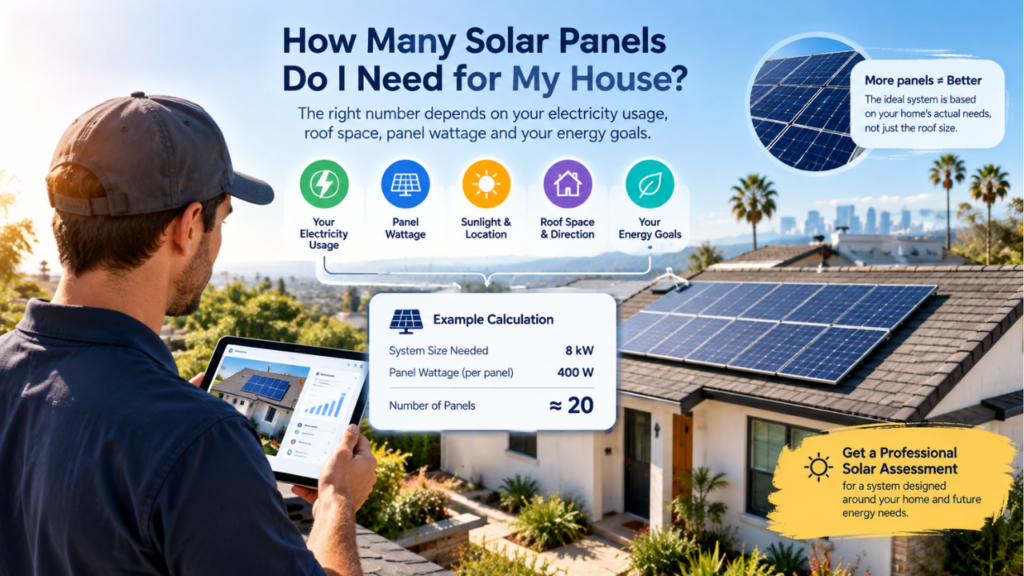
As a simple example, suppose a home needs an approximately 8 kW solar system and the selected panels are rated at 400 watts each:
8,000 watts ÷ 400 watts = 20 panels
That means the system would require approximately 20 panels.
The actual number can change after evaluating the home’s electricity usage, roof conditions, shading, equipment, and expected solar production.
What Determines How Many Solar Panels You Need?
Several factors influence solar panel quantity.
1. Your Monthly Electricity Usage
Your electricity consumption is one of the most important factors.
Look at your utility bills and determine how many kilowatt-hours (kWh) your household uses each month.
For example, if your bills show:
January: 650 kWh
February: 720 kWh
March: 680 kWh
April: 750 kWh
May: 900 kWh
June: 1,050 kWh
Your summer electricity usage may be considerably higher than your winter usage.
This is why looking at only one month’s bill may not provide an accurate picture.
Ideally, review approximately 12 months of electricity usage when planning a solar installation.
2. Solar Panel Wattage
The power rating of the panel affects how many panels are required.
For example, a 6 kW system could theoretically be built using:
400-watt panels:
6,000 ÷ 400 = 15 panels
450-watt panels:
6,000 ÷ 450 ≈ 14 panels
The system size is still approximately 6 kW, but the higher-wattage panels reduce the number of individual panels required.
This can be useful when roof space is limited.
3. Your Location and Sunlight
Solar panels do not produce the same amount of electricity everywhere.
The amount of sunlight available depends on location, weather, roof orientation, shading, and seasonal conditions.
For homes in Southern California, strong solar resources can make rooftop solar an attractive option, but individual properties can still have very different production levels.
A roof with significant shade from trees or nearby buildings may produce less electricity than a similarly sized roof with unobstructed sunlight.
4. Roof Direction and Angle
Roof orientation can affect solar production.
The available roof surfaces should be evaluated to determine where panels can be installed and how much usable space is available.
An installer may also need to consider:
- Roof pitch
- Roof orientation
- Chimneys
- Vents
- Skylights
- HVAC equipment
- Trees
- Nearby buildings
- Roof condition
The goal is not simply to fit as many panels as possible onto the roof.
The system should be designed around the roof’s usable areas and expected energy production.
5. Your Solar Energy Goals
Another important question is how much of your electricity usage you want solar to cover.
Some homeowners want a system designed to offset a large portion of their annual electricity consumption.
Others may have limited roof space and install a smaller system.
Your goal could also change if you are planning to add new electrical loads in the future.
For example, a homeowner may be considering:
- An electric vehicle
- EV charger
- Battery storage
- Electric water heater
- Heat pump
- Mini split system
- Home addition
- ADU
- Pool equipment
Future electricity usage should be considered before finalizing the solar system design.
How to Calculate the Number of Solar Panels
You can use a basic calculation to understand the relationship between system size and panel count.
Step 1: Determine the Required Solar System Size
Suppose your home needs an estimated 8 kW solar system.
Step 2: Determine Panel Wattage
Assume each panel produces 400 watts.
Step 3: Divide System Size by Panel Wattage
8,000 watts ÷ 400 watts = 20 panels
So you would need approximately 20 solar panels for an 8 kW system using 400-watt panels.
This is a planning calculation, not a final system design.
The actual system size should be determined using your electricity consumption and expected site-specific solar production.
Solar Panel Examples by System Size
The following examples show approximately how many 400-watt panels would be needed for different system sizes:
| Solar System Size | Approx. Number of 400W Panels |
|---|---|
| 4 kW | 10 panels |
| 5 kW | 13 panels |
| 6 kW | 15 panels |
| 7 kW | 18 panels |
| 8 kW | 20 panels |
| 9 kW | 23 panels |
| 10 kW | 25 panels |
| 12 kW | 30 panels |
These numbers are based only on dividing system capacity by 400 watts. Actual solar designs may use different panel wattages and may be adjusted based on roof space, production requirements, equipment specifications, and electrical considerations.
How Many Solar Panels Do I Need for a 2,000-Square-Foot House?
A common misconception is that you can determine the number of solar panels simply from the home’s square footage.
A 2,000-square-foot house does not automatically need a specific number of panels.
Two homes with the same floor area can have completely different electricity consumption.
One household may use electricity efficiently and have low monthly usage. Another may have central air conditioning, an electric vehicle, electric appliances, a pool, and other high-energy equipment.
For this reason, electricity usage is generally more useful than square footage when estimating solar requirements.
How Many Solar Panels Do I Need for a 1,500-Square-Foot House?
The same principle applies to a 1,500-square-foot home.
The number of panels depends on how much electricity the household uses and how much energy the proposed solar system can produce at that property.
For example, a homeowner with relatively low electricity usage might need a smaller system than another 1,500-square-foot home with high electricity consumption.
The roof itself also matters. A smaller usable roof area may require higher-wattage panels to achieve the desired system capacity without installing too many individual panels.
What If My Electricity Usage Is High?
High electricity consumption does not necessarily mean solar is impractical.
It may simply mean the home requires a larger system.
High electricity usage can come from:
- Air conditioning
- Electric heating
- Pool pumps
- Electric water heaters
- EV charging
- Electric appliances
- Home offices
- Large households
- Older inefficient equipment
If your electricity usage is high, an installer should evaluate whether the roof has enough usable area for the desired system.
If the roof cannot accommodate the required number of panels, other options may need to be considered.
Do Solar Batteries Reduce the Number of Panels Needed?
A battery does not automatically reduce the number of solar panels required to produce the electricity your home consumes.
Instead, battery storage changes when you can use the energy generated by your solar system.
During the day, solar panels can generate electricity. A battery can store some of that energy for later use, depending on system design and available capacity.
This can be particularly useful for homeowners who want to use more of their solar energy outside of daylight hours.
The appropriate combination of solar panels and battery storage depends on the home’s electricity consumption, solar production, utility rate structure, backup-power goals, and other factors.
What Happens If You Install Too Few Panels?
A smaller solar system will generally produce less electricity.
If your goal is to offset a large portion of your electricity consumption, installing too few panels may leave you purchasing more electricity from the utility.
This does not necessarily make a smaller system wrong.
Some homeowners intentionally install a smaller system because of:
- Limited roof space
- Budget constraints
- Current electricity usage
- Future expansion plans
- Property limitations
The important thing is to understand how much electricity the proposed system is expected to produce.
What Happens If You Install Too Many Panels?
More panels are not automatically better.
The system should be designed around your electricity usage, available roof area, electrical infrastructure, equipment specifications, and applicable utility requirements.
Adding panels without considering these factors can result in unnecessary equipment and installation costs.
A professional solar design should balance production goals with the physical and electrical characteristics of the property.
Can Your Roof Fit Enough Solar Panels?
Before determining the final number of panels, the roof should be evaluated.
A solar installer may look at:
- Total roof area
- Usable roof area
- Roof orientation
- Roof pitch
- Shading
- Roof condition
- Obstructions
- Panel dimensions
- Required clearances
For example, a large roof may not have as much usable solar space as it appears to have if large portions are shaded or occupied by vents, chimneys, skylights, or other equipment.
Should You Replace Your Roof Before Installing Solar?
If your roof is near the end of its useful life, it may be worth addressing the roof before installing a new solar system.
Solar panels are designed to remain in place for many years. Installing them on a roof that will soon require replacement can create additional work because the panels may need to be removed and reinstalled.
A professional evaluation can help determine whether the roof and solar project should be coordinated.
How ReVamp Energy Can Help Determine Your Solar Panel Needs
Choosing the right number of solar panels requires more than counting panels.
ReVamp Energy can evaluate your property’s electricity requirements, roof conditions, electrical system, and solar goals to help determine an appropriate residential solar system.
A professional design can take into account current energy usage as well as potential future needs such as EV charging, battery storage, HVAC upgrades, or other electrical loads.
The goal is to design a system that fits the property rather than simply installing the maximum possible number of panels.
Final Thoughts
So, how many solar panels do you need for your house?
There is no universal number.
A homeowner’s electricity consumption, panel wattage, solar production, roof space, shading, roof orientation, and future energy needs all affect the final design.
As a simple example, an 8 kW system using 400-watt panels would require approximately 20 panels. But the correct system size for your home may be smaller or larger depending on your actual electricity consumption and property conditions.
If you are considering solar in Los Angeles or Southern California, start by reviewing your electricity usage over the past year. Then have the property professionally evaluated to determine how much solar production is practical for your roof and electrical system.
A properly designed solar system should be based on your home’s actual energy needs—not simply the size of your house or the number of panels that can fit on the roof.