
Introduction
Warehouses can be challenging spaces to heat and cool efficiently. Large open areas, high ceilings, frequently opened loading doors, poor insulation, and changing outdoor temperatures can all increase energy consumption.
For warehouse owners and facility managers, choosing the right Energy Efficient Climate Control system is important for maintaining comfortable working conditions without unnecessarily increasing operating costs.
Modern climate control solutions can help warehouses maintain more consistent temperatures while using energy more efficiently. Depending on the building’s size, layout, insulation, occupancy, and operational requirements, options can include ductless mini splits, high-efficiency HVAC systems, ventilation systems, smart thermostats, and improved insulation.
This guide explains the best climate control options for warehouses and what businesses should consider before choosing a system.
Why Warehouse Climate Control Is Different
A warehouse is very different from a typical office or residential building.
Large warehouses often have:
- High ceilings
- Large open floor areas
- Loading and unloading doors
- Storage racks
- Limited interior walls
- Variable occupancy
- Heat-producing equipment
- Frequent air movement
These conditions make it difficult for a single conventional HVAC system to maintain an even temperature throughout the entire facility.
An efficient climate control strategy should therefore be designed around how the warehouse is actually used.
What Is Energy Efficient Climate Control?
Energy Efficient Climate Control refers to heating, cooling, ventilation, and temperature-management systems designed to maintain indoor conditions while minimizing unnecessary energy consumption.
An efficient warehouse climate strategy may combine several technologies rather than relying on one system.
Common solutions include:
- Ductless mini split systems
- High-efficiency commercial HVAC
- Zoned climate control
- Smart thermostats
- Energy-efficient ventilation
- Improved insulation
- Air sealing
- High-speed doors
The right combination depends on the building and its operational requirements.
Ductless Mini Split Systems
Ductless mini splits can be an excellent option for warehouses that need targeted heating and cooling.
Instead of distributing conditioned air through a large duct network, mini splits use individual indoor units connected to an outdoor unit.
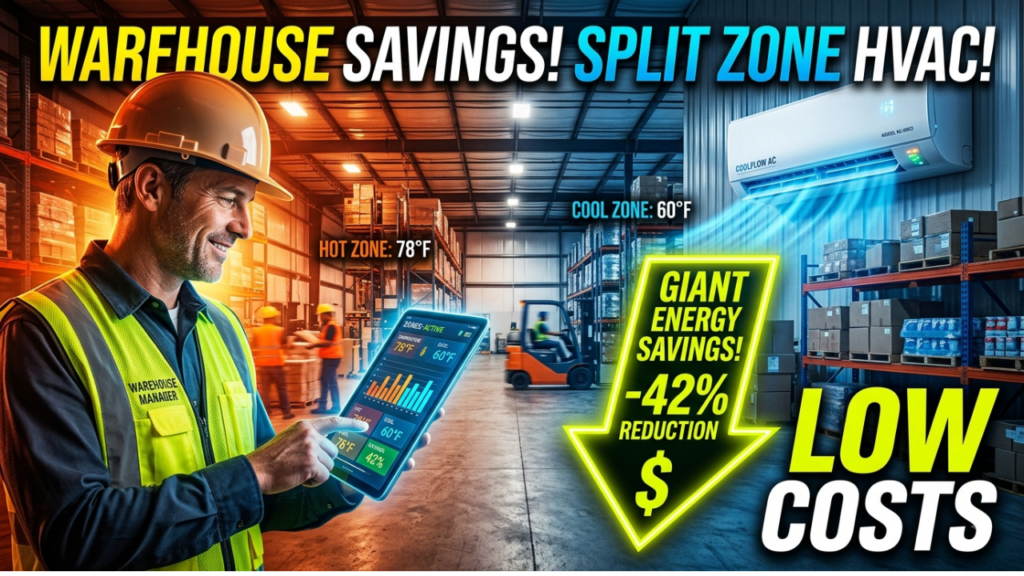
This allows businesses to create separate temperature zones.
Mini splits can be particularly useful for:
- Warehouse offices
- Break rooms
- Security areas
- Small work zones
- Shipping departments
- Areas requiring independent temperature control
One major advantage is that businesses do not have to condition every part of a large warehouse equally when only certain areas require climate control.
Zoned HVAC Systems
Zoning is another effective way to improve warehouse energy efficiency.
Instead of maintaining the same temperature throughout the entire building, different areas can be controlled independently.
For example, a warehouse might have separate zones for:
- Office areas
- Storage areas
- Employee spaces
- Production areas
- Loading areas
Zoning allows businesses to focus heating and cooling where it is actually needed.
High-Efficiency Commercial HVAC
For larger warehouses requiring whole-building climate control, a high-efficiency commercial HVAC system may be appropriate.
Modern systems can provide improved performance compared with older equipment.
When evaluating commercial HVAC equipment, businesses should consider:
- System efficiency
- Cooling capacity
- Heating capacity
- Building size
- Maintenance requirements
- Expected operating schedule
Proper sizing is particularly important. An oversized or undersized system can operate inefficiently and create inconsistent indoor temperatures.
Smart Thermostats and Controls
Smart controls can significantly improve Energy Efficient Climate Control.
Modern controls allow businesses to automatically adjust temperatures based on:
- Occupancy
- Time of day
- Work schedules
- Outdoor temperatures
- Building conditions
For example, climate control can be reduced during periods when a warehouse is unoccupied.
This prevents unnecessary heating and cooling while maintaining comfortable conditions when employees arrive.
Improve Warehouse Insulation
Even the most efficient HVAC equipment cannot perform properly if a building loses conditioned air rapidly.
Improving insulation can help reduce heating and cooling demand.
Important areas include:
- Roof insulation
- Exterior walls
- Doors
- Windows
- Loading areas
- Gaps around building openings
Better insulation helps maintain indoor temperatures and reduces the amount of work required from HVAC equipment.
Control Air Loss Around Loading Doors
Warehouse loading doors can be a major source of energy loss.
Every time a large door opens, conditioned air can escape while outdoor air enters.
Businesses can reduce this problem with:
- High-speed doors
- Door seals
- Dock shelters
- Automatic door controls
- Air curtains
These improvements can complement an efficient HVAC system and help maintain more stable indoor temperatures.
Warehouse Ventilation
Ventilation is another important part of climate control.
Warehouses may require ventilation to remove:
- Heat
- Dust
- Fumes
- Excess humidity
- Stale air
However, ventilation should be properly designed because excessive outdoor air can increase heating and cooling requirements.
A professional evaluation can help determine the appropriate ventilation strategy for the facility.
Ceiling Fans and Air Circulation
Large warehouses can benefit from improved air circulation.
High-volume, low-speed fans can help distribute air more evenly throughout large spaces.
Better circulation can reduce temperature differences between the floor and ceiling and improve employee comfort.
Fans do not replace heating or cooling systems, but they can complement them.
Solar Energy and Warehouse Climate Control
Commercial solar can also support a warehouse’s overall energy strategy.
Warehouses often have large rooftop areas that may be suitable for solar installation.
Solar energy can help offset electricity used by:
- HVAC equipment
- Lighting
- Refrigeration
- Warehouse machinery
- EV chargers
Combining solar energy with efficient climate control can help businesses reduce long-term operating expenses.
Battery Storage for Large Facilities
Battery storage can provide another layer of energy management.
A commercial battery system can store electricity and make it available when needed.
Potential benefits include:
- Better energy management
- Reduced peak demand
- Backup power capability
- Greater energy flexibility
For warehouses with high electricity consumption, battery storage may complement both solar and energy-efficient HVAC systems.
Choosing the Right System for Your Warehouse
There is no single climate control solution that works for every warehouse.
Before choosing equipment, consider:
Building Size
Larger warehouses may require multiple systems or zones rather than one centralized system.
Ceiling Height
High ceilings can create significant temperature differences between floor-level work areas and upper sections of the building.
Occupancy
A warehouse occupied throughout the day may require a different strategy from a facility used only during certain shifts.
Door Usage
Facilities with frequently opened loading doors may need additional strategies to control air loss.
Insulation
Poor insulation can significantly increase heating and cooling requirements.
Future Expansion
New equipment, additional employees, EV chargers, or expanded operations may increase future energy demand.
Common Warehouse Climate Control Mistakes
Using One Temperature for the Entire Building
Different areas often have different requirements. Zoning can improve comfort and efficiency.
Installing Oversized Equipment
Bigger does not always mean better. Proper sizing is essential for efficient operation.
Ignoring Insulation
HVAC upgrades may provide limited results if conditioned air is constantly escaping.
Neglecting Maintenance
Dirty filters, blocked airflow, and poorly maintained equipment can reduce efficiency.
Ignoring Future Energy Needs
Warehouse operations often change over time. Climate control should be planned with future growth in mind.
Maintenance Matters
Regular maintenance helps keep climate control systems operating efficiently.
Businesses should monitor:
- Air filters
- Refrigerant levels
- Electrical connections
- Coils
- Ductwork
- Thermostats
- Outdoor units
Addressing small problems early can help prevent larger equipment issues and unnecessary energy consumption.
Why Businesses Choose ReVamp Energy Solutions
At ReVamp Energy Solutions, we help commercial property owners improve building efficiency with customized electrical and climate control solutions.
Our services include:
- Mini split installation
- Commercial electrical services
- Electrical upgrades
- Energy-efficient system planning
- Solar installation
- Battery storage
- EV charger installation
We evaluate the property’s existing infrastructure and help businesses develop solutions that support comfort, efficiency, and long-term operational needs.
Conclusion
Choosing the right Energy Efficient Climate Control system can make a significant difference for warehouse owners.
From ductless mini splits and zoned HVAC to smart controls, insulation improvements, and better ventilation, businesses have several options for improving temperature control while reducing unnecessary energy consumption.
The best solution depends on the warehouse’s size, layout, occupancy, insulation, equipment, and daily operations.
A professional assessment can help identify the right combination of technologies and ensure the system is properly sized for the property.
FAQs
What is the most energy-efficient climate control option for a warehouse?
The best option depends on the warehouse. Ductless mini splits, zoned HVAC, high-efficiency commercial systems, and smart controls can all provide energy-efficient solutions when properly designed.
Are mini splits good for warehouses?
Mini splits can work well for smaller warehouse areas, offices, break rooms, and spaces that require independent temperature control.
How can warehouses reduce HVAC energy costs?
Improving insulation, controlling loading-door air loss, using smart thermostats, maintaining equipment, and creating separate climate zones can help reduce energy consumption.
Does warehouse insulation affect HVAC efficiency?
Yes. Better insulation helps maintain indoor temperatures and reduces the amount of heating or cooling required.
Can solar power support warehouse HVAC systems?
Yes. Commercial solar can help offset the electricity consumed by HVAC equipment and other warehouse operations.
How can ReVamp Energy Solutions help?
ReVamp Energy Solutions provides mini split installation, commercial electrical services, solar installation, battery storage, and other energy solutions designed to improve commercial property efficiency.