
Table of Contents
As electric vehicles become more common, understanding the different EV charger types has become increasingly important for homeowners, property managers, businesses, and contractors. Not every EV charger provides the same charging speed, electrical requirements, or installation setup. Choosing the right option depends on how the vehicle will be used, where the charger will be installed, and how much charging capacity is needed.
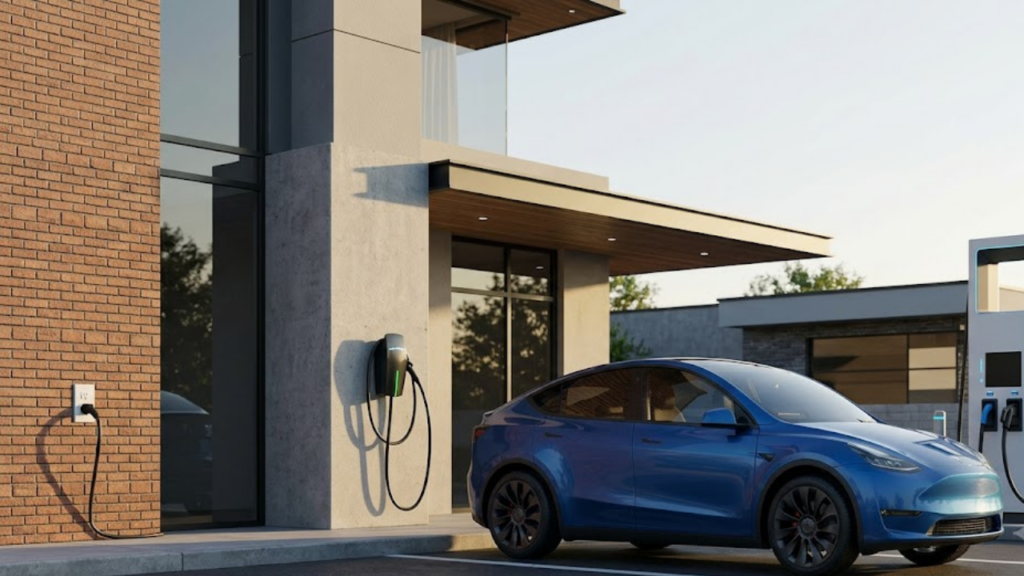
The three main EV charging options are Level 1, Level 2, and DC fast charging. Each type serves a different purpose. Level 1 charging is generally suitable for basic home charging, Level 2 provides significantly faster charging for homes and commercial properties, and DC fast charging is designed for rapid charging in commercial and public locations.
Understanding these differences can help property owners make better decisions before beginning an EV charging project.
What Are EV Charger Types?
The term EV charger types generally refers to the different levels of charging equipment available for electric vehicles. These chargers differ primarily in electrical power, charging speed, installation requirements, and typical applications.
The three primary categories are:
- Level 1 charging
- Level 2 charging
- DC fast charging
The right charger depends on the property, vehicle, available electrical capacity, expected usage, and charging requirements.
What Is a Level 1 EV Charger?
Level 1 is the simplest form of EV charging. It typically uses a standard household electrical outlet and does not usually require a dedicated high-power charging circuit.
Because Level 1 charging uses relatively low electrical power, charging is much slower than the other options. However, it can be useful for drivers who have relatively low daily mileage and can leave their vehicle connected for long periods.
Level 1 charging may work well when:
- The vehicle is driven only occasionally
- Daily mileage is relatively low
- The vehicle can charge overnight
- Faster charging is not necessary
- The property does not require a dedicated EV charging system
One advantage of Level 1 charging is its simplicity. However, the slower charging speed can become inconvenient for drivers who regularly use their EV and need to replenish a significant amount of battery capacity every day.
What Is a Level 2 EV Charger?
Level 2 charging is a popular option for both residential and commercial EV charging. It operates at a higher voltage than Level 1 and can provide substantially faster charging.
A Level 2 charger generally requires a dedicated electrical circuit and proper installation. Depending on the property and charger specifications, an electrical professional may need to evaluate the electrical panel, available capacity, wiring, circuit protection, and installation location.
Level 2 charging is commonly used for:
- Single-family homes
- Apartment buildings
- Offices
- Retail properties
- Hotels
- Commercial parking areas
- Workplaces
For many EV owners, Level 2 offers a practical balance between charging speed and installation requirements.
A homeowner who drives regularly may find Level 2 much more convenient than relying on a standard household outlet. Businesses can also use Level 2 chargers as an employee or customer amenity.
What Is DC Fast Charging?
DC fast charging is designed for situations where vehicles need to charge much more quickly. Unlike Level 1 and Level 2 systems, which supply alternating current that is converted by the vehicle, DC fast chargers provide direct current to the vehicle’s battery through the charging equipment.
DC fast charging equipment typically requires significantly more electrical infrastructure than residential charging equipment.
These chargers are commonly found at:
- Public charging stations
- Highway charging locations
- Commercial properties
- Fleet facilities
- Automotive service locations
- High-traffic parking areas
DC fast charging can be particularly valuable for drivers who need to minimize charging time during longer trips.
However, the higher charging capacity also means that installation can involve more extensive electrical planning, equipment requirements, utility considerations, and site preparation.
Level 1 vs. Level 2 vs. DC Fast Charging
The biggest difference between these EV charger types is charging speed and infrastructure requirements.
| Charger Type | Typical Use | Charging Speed | Installation |
|---|---|---|---|
| Level 1 | Basic residential charging | Slow | Usually simplest |
| Level 2 | Homes and commercial properties | Faster | Dedicated electrical circuit typically required |
| DC Fast | Public and commercial charging | Very fast | More complex electrical infrastructure |
The best choice depends on the property’s electrical system and how the charger will be used.
A homeowner with limited daily driving may be satisfied with Level 1. A homeowner who drives frequently may prefer Level 2. A business serving customers, fleets, or high-volume EV traffic may need Level 2 or DC fast charging depending on its specific requirements.
What Should You Consider Before Installing an EV Charger?
Selecting a charger should not be based on charging speed alone. Several other factors should be evaluated before installation.
Electrical Panel Capacity
The existing electrical panel needs to have sufficient capacity for the proposed charger. If the panel does not have enough available capacity, an electrical upgrade may be necessary.
Available Space
The physical location of the charger matters. The installation may require appropriate wall space, parking access, conduit routing, wiring, and protection from environmental conditions.
Daily Driving Habits
A driver who travels only a few miles per day may not need the same charging equipment as someone who drives long distances every day.
Property Type
Residential, multifamily, commercial, and fleet properties can have very different electrical and operational requirements.
Future EV Demand
Businesses should also consider whether EV charging demand may increase over time. Planning for future expansion can help avoid unnecessary redesign or electrical work later.
EV Charger Installation Requires Proper Planning
Installing an EV charger is more than simply purchasing charging equipment and connecting it to electricity.
A proper project may involve site assessment, electrical planning, equipment selection, permitting, scheduling, installation, inspection, and customer communication.
For contractors and property owners, keeping these steps organized can become challenging when multiple projects are being managed at the same time.
Administrative coordination can help keep project information, customer details, schedules, documents, and follow-ups organized throughout the process.
This becomes especially important for contractors handling multiple EV charging projects across different properties.
Why Project Coordination Matters for EV Charging Projects
EV charging projects can involve several moving parts. A customer may need an initial consultation, an estimate, permit coordination, installation scheduling, inspection, and follow-up communication.
Without a consistent workflow, important details can easily become difficult to track.
Contractors can benefit from organized processes for:
- Customer communication
- Lead and estimate tracking
- Project scheduling
- Permit coordination
- Document management
- Payment follow-up
- Customer follow-ups
- Internal task management
A structured workflow allows contractors to spend more time focusing on field operations while administrative tasks remain organized.
How to Choose the Right EV Charger
Choosing between Level 1, Level 2, and DC fast charging starts with understanding the property’s actual needs.
For basic residential use, Level 1 may be sufficient. For regular daily driving and faster overnight charging, Level 2 is often a more practical option. For commercial locations where drivers need rapid charging, DC fast charging may be worth considering.
Before making a decision, property owners should evaluate:
- How frequently the vehicle will be charged
- How many vehicles need charging
- Available electrical capacity
- Installation location
- Expected charging demand
- Property type
- Future expansion needs
- Project budget and infrastructure requirements
The goal is not simply to choose the fastest charger. It is to choose a charging solution that matches the property’s electrical infrastructure and actual usage.
Final Thoughts
Understanding EV charger types makes it easier for homeowners, businesses, and contractors to determine which charging solution may be appropriate for a particular property. Level 1 provides basic charging, Level 2 offers faster and more practical charging for many residential and commercial applications, and DC fast charging is designed for rapid charging where higher electrical capacity is available.
For contractors, however, successful EV charging projects involve more than equipment installation. Customer communication, permit coordination, scheduling, documentation, payment coordination, and workflow management can all affect how efficiently projects are completed.
As EV adoption continues to grow, contractors will need organized systems to manage increasing project volume. A well-structured administrative and operational process can help keep EV charging projects organized from the initial customer inquiry through completion.