
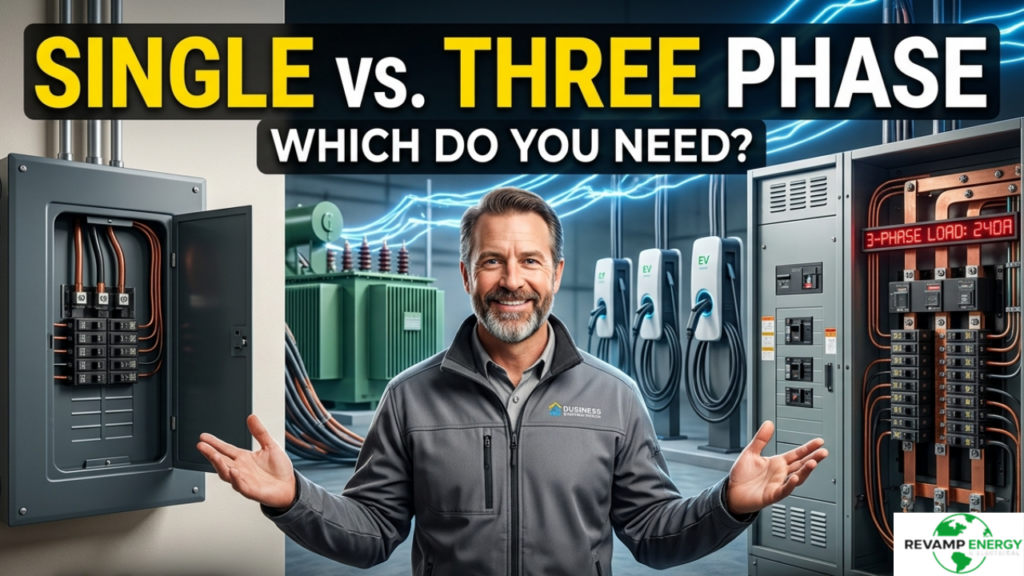
Introduction
Electricity is one of the most important parts of running a modern business. From lighting and computers to HVAC systems, machinery, refrigeration, EV chargers, and other commercial equipment, businesses depend on a reliable electrical system every day.
As a business grows, its electrical demand can also increase. A system that was sufficient when the company first opened may eventually struggle to support additional equipment and expanding operations.
This is where Three-Phase Electrical Service can become an important consideration.
Three-phase power is commonly used in commercial and industrial properties because it can efficiently deliver electricity to larger electrical loads. It can provide the capacity needed for demanding equipment while supporting a more balanced electrical system.
But does every business need three-phase power?
Not necessarily.
The right electrical service depends on the size of your property, equipment, energy demand, and future expansion plans. Understanding how three-phase electrical service works can help you determine whether an upgrade makes sense for your business.
What Is Three-Phase Electrical Service?
Three-Phase Electrical Service is an electrical power system that uses three alternating currents operating together to deliver electricity.
Instead of relying on a single alternating current, three-phase systems distribute electrical power across three phases.
This makes the system particularly useful for commercial and industrial applications where electrical loads can be significantly higher than those found in typical residential properties.
A commercial three-phase system can support equipment such as:
- Large HVAC systems
- Commercial refrigeration
- Industrial machinery
- Pumps
- Compressors
- Elevators
- Commercial kitchen equipment
- EV charging systems
The exact configuration and voltage depend on the property’s electrical design and utility service.
Three-Phase vs Single-Phase Power
Understanding the difference between single-phase and three-phase power is important when evaluating your business’s electrical infrastructure.
Single-Phase Power
Single-phase electrical service is commonly used for residential properties and smaller commercial applications.
It can support:
- Lighting
- Computers
- Office equipment
- Small appliances
- Basic HVAC equipment
For businesses with relatively low electrical demand, single-phase service may be completely adequate.
Three-Phase Power
Three-phase systems are commonly used where businesses require higher electrical capacity.
They can provide power for:
- Heavy machinery
- Large HVAC equipment
- Commercial refrigeration
- Manufacturing equipment
- Large pumps
- EV charging infrastructure
The important point is that three-phase power isn’t automatically “better” for every business. It is designed to meet a different level and type of electrical demand.
How Does Three-Phase Power Work?
A three-phase electrical system distributes power across three phases that are offset from each other.
This creates a more continuous flow of electrical power compared with single-phase systems.
For businesses using motors and other heavy equipment, this can provide several advantages.
Three-phase motors, for example, can operate smoothly because power is continuously available across the phases.
This is one reason three-phase systems are widely used in commercial and industrial environments.
Benefits of Three-Phase Electrical Service
Businesses with high electrical demand can benefit from several advantages.
Higher Electrical Capacity
Three-phase systems can support larger electrical loads, making them suitable for businesses operating multiple high-powered devices.
Efficient Power Distribution
Electrical power can be distributed across three phases, helping manage larger loads efficiently.
Better Support for Commercial Equipment
Many commercial and industrial machines are designed specifically for three-phase power.
Improved Motor Performance
Three-phase motors can provide smooth and efficient operation for equipment such as pumps, compressors, and machinery.
Supports Business Expansion
A properly designed electrical system can provide the infrastructure needed for future equipment and operational growth.
Which Businesses Need Three-Phase Electrical Service?
Three-phase power is particularly common in businesses with substantial electrical requirements.
Examples include:
- Manufacturing facilities
- Warehouses
- Restaurants
- Commercial kitchens
- Automotive repair facilities
- Hotels
- Large office buildings
- Retail centers
- Medical facilities
- Industrial facilities
- Distribution centers
However, the type of business alone doesn’t determine whether three-phase service is necessary.
The actual electrical load is what matters most.
Does Your Business Need Three-Phase Power?
Several signs may indicate that your current electrical service should be evaluated.
You’re Adding Heavy Equipment
If your business is installing machinery, large HVAC systems, refrigeration equipment, or other high-powered devices, your existing electrical service may not have sufficient capacity.
Breakers Frequently Trip
Repeated breaker trips can indicate an overloaded circuit or another electrical problem.
However, frequent trips should not automatically be interpreted as proof that you need three-phase power. A professional inspection is necessary to determine the actual cause.
You’re Expanding Your Facility
Adding new rooms, equipment, production areas, or workspaces can significantly increase electrical demand.
You’re Installing Multiple EV Chargers
Commercial EV charging can create substantial electrical loads.
Businesses planning several charging stations should evaluate their electrical service before installation.
You’re Operating Large Motors
Equipment such as compressors, pumps, and industrial machinery may require three-phase power.
Three-Phase Power for EV Charging
The growth of electric vehicles has changed the electrical requirements of many commercial properties.
Businesses may install EV chargers for:
- Employees
- Customers
- Company vehicles
- Delivery fleets
- Commercial fleets
Multiple high-powered chargers can place significant demand on an electrical service.
A three-phase electrical system may provide a suitable foundation for certain commercial charging installations, but the required configuration depends on the charger specifications and available electrical capacity.
Before adding EV chargers, businesses should have their electrical infrastructure evaluated.
Three-Phase Power and Commercial HVAC
Heating and cooling systems can represent a significant portion of a commercial building’s electrical demand.
Large HVAC equipment may use three-phase power, particularly in larger buildings.
If you’re replacing an older HVAC system with larger equipment, it’s important to determine whether your existing electrical service can support the new system.
Three-Phase Electrical Service for Warehouses
Warehouses often have unique electrical requirements.
Equipment may include:
- Industrial lighting
- HVAC systems
- Refrigeration
- Conveyors
- Forklift charging
- Pumps
- Compressors
- EV fleet chargers
A three-phase electrical system can provide the infrastructure needed to support many of these applications.
However, proper load calculations should be completed before deciding whether an upgrade is necessary.
Signs Your Electrical System May Be Undersized
Your business should consider an electrical evaluation if you experience:
- Frequent breaker trips
- Flickering lights
- Voltage problems
- Overloaded circuits
- Equipment shutdowns
- Difficulty adding new equipment
- Electrical components becoming unusually warm
- Plans for major expansion
These problems can have multiple causes, so professional troubleshooting is important.
What Is Involved in a Three-Phase Electrical Upgrade?
If your business does require Three-Phase Electrical Service, the project may involve several steps.
Electrical Load Assessment
A professional evaluates current and anticipated electrical demand.
Service Capacity Evaluation
The existing electrical service, panel, wiring, and equipment are reviewed.
Utility Coordination
Depending on the project, coordination with the utility provider may be required.
Electrical Equipment Installation
The appropriate panels, disconnects, wiring, protection equipment, and related components are installed.
Testing and Inspection
The completed system is tested to ensure proper operation and compliance with applicable requirements.
The exact process depends on the property and project scope.
Planning for Future Growth
One of the biggest mistakes businesses make is designing an electrical system only for today’s needs.
Consider what your business may add over the next several years.
Future electrical loads could include:
- More employees
- Additional HVAC equipment
- Manufacturing machinery
- EV chargers
- Solar panels
- Battery storage
- New refrigeration systems
- Facility expansion
Planning ahead can help prevent repeated electrical upgrades.
Three-Phase Power and Solar Energy
Commercial solar systems can be integrated with three-phase electrical systems.
Businesses with large electricity consumption may use solar energy to offset power purchased from the utility.
A commercial solar project may also involve:
- Electrical panel upgrades
- Service upgrades
- Battery storage
- Energy monitoring
- EV charging
Combining these technologies requires careful electrical planning.
Common Mistakes Businesses Make
Assuming Three-Phase Is Always Better
Not every business needs three-phase power. Installing unnecessary infrastructure can increase project costs.
Ignoring Future Equipment
A business may install a new electrical system and then discover that future equipment requires additional capacity.
Adding EV Chargers Without an Electrical Assessment
Multiple chargers can significantly increase electrical demand.
Focusing Only on the Panel
The electrical panel is only one part of the overall service. Wiring, utility capacity, disconnects, and other components must also be considered.
Choosing Equipment Without Professional Load Calculations
Electrical demand should be calculated rather than estimated.
Why Professional Electrical Planning Matters
Commercial electrical systems need to be designed around the property’s actual requirements.
A professional evaluation can help determine:
- Current electrical capacity
- Peak demand
- Future electrical requirements
- Equipment compatibility
- Panel capacity
- Service upgrade requirements
- EV charging needs
- Solar and battery integration opportunities
This allows businesses to invest in the right infrastructure instead of simply installing more electrical capacity than necessary.
Why Businesses Choose ReVamp Energy Solutions
At ReVamp Energy Solutions, we help commercial property owners evaluate and improve their electrical infrastructure.
Our commercial services include:
- Three-phase electrical service
- Electrical service upgrades
- Electrical panel upgrades
- Commercial electrical installation
- EV charger installation
- Commercial solar installation
- Battery storage solutions
- Electrical load planning
We help businesses build reliable electrical systems that support current operations and future growth.
Conclusion
Three-Phase Electrical Service can be an important solution for businesses with high electrical demands, heavy equipment, large HVAC systems, multiple EV chargers, or plans for expansion.
However, not every business needs three-phase power.
The best approach is to evaluate your current electrical consumption, equipment requirements, and future plans before deciding whether an upgrade makes sense.
A properly designed electrical system can provide the capacity, reliability, and flexibility your business needs while helping you avoid unnecessary infrastructure costs.
FAQs
What is Three-Phase Electrical Service?
Three-Phase Electrical Service distributes electrical power across three alternating phases and is commonly used for commercial and industrial applications with higher electrical demands.
Does every business need three-phase power?
No. Smaller businesses with lower electrical loads may operate effectively with single-phase power. The right system depends on the property’s actual electrical requirements.
What businesses commonly use three-phase power?
Manufacturing facilities, warehouses, restaurants, commercial kitchens, large offices, automotive facilities, and other properties with substantial electrical loads commonly use three-phase power.
Can three-phase power support EV chargers?
Yes. Three-phase electrical systems can support many commercial EV charging applications, depending on the charger specifications and available electrical capacity.
Can solar be installed with three-phase electrical service?
Yes. Commercial solar systems can be integrated with three-phase electrical infrastructure when properly designed.
How do I know if my business needs an electrical upgrade?
A professional electrical load assessment can determine whether your existing service has enough capacity for current equipment and planned future expansion.
How can ReVamp Energy Solutions help?
ReVamp Energy Solutions provides commercial electrical upgrades, three-phase electrical services, EV charger installation, solar installation, battery storage, and electrical planning for growing businesses.