
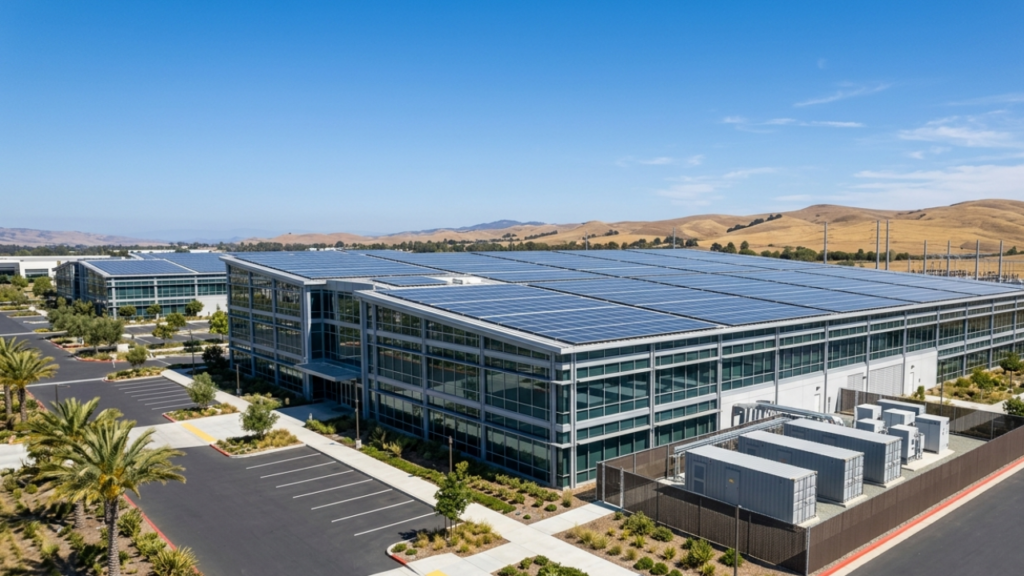
For commercial property owners in California, solar energy can do more than reduce dependence on the utility grid. A properly designed solar and battery system can help lower electricity costs, improve energy management, and provide greater control over a property’s long-term operating expenses.
One of the most important concepts to understand before installing commercial solar is net metering. However, California’s solar billing rules have changed significantly. New solar customers generally no longer enter the traditional NEM 2.0 program. For interconnection applications submitted on or after April 15, 2023, California’s Net Billing Tariff (NBT) applies to customers who would previously have used standard NEM tariffs.
For commercial property owners, understanding the difference between traditional net metering and today’s net billing structure is essential when evaluating a solar investment.
What Is Net Metering?
Net metering is a billing mechanism that allows a property with an eligible renewable energy system to receive credits for electricity sent back to the utility grid.
A commercial solar system generally works in this order:
- Solar energy is generated on the property.
- The electricity is first used by the building.
- Any excess generation can be exported to the electrical grid.
- The applicable tariff determines how the exported electricity is credited.
- The credits can reduce the property’s electricity bill.
Under traditional NEM tariffs, exported electricity could receive credits based on the customer’s applicable retail electricity rate. California’s traditional NEM tariffs are now closed to new enrollments, although existing customers can remain under their applicable legacy tariff rules.
This distinction is especially important for businesses considering a new commercial solar installation.
Is NEM 2.0 Still Available for New Commercial Solar Projects?
Generally, no.
California replaced NEM 2.0 with the Net Billing Tariff for new interconnection applications beginning April 15, 2023. The CPUC describes NBT as the successor to NEM 2.0.
Existing NEM customers may continue receiving benefits under their applicable legacy tariff. The CPUC states that NEM 2.0 customers can remain on that tariff for 20 years from their interconnection date, subject to the applicable rules.
For a commercial property owner installing solar today, however, the financial analysis should generally be based on the current net billing structure rather than assuming the property will receive traditional NEM 2.0 retail-rate credits.
What Is California’s Net Billing Tariff?
California’s Net Billing Tariff changes how excess solar electricity is valued.
Under NBT, electricity produced by the solar system is first used to serve the property’s onsite electricity demand. This directly reduces the amount of electricity the business needs to purchase from the utility.
When the system generates more electricity than the property is using, the excess can be exported to the grid. Instead of automatically receiving a retail-rate credit equivalent to the property’s electricity purchase rate, the exported energy receives compensation based on the value of electricity to the grid during the relevant period.
This means using solar electricity onsite can be particularly important for commercial properties.
A business that consumes a large portion of its solar generation during operating hours may be able to capture more value from its system than a property that consistently produces large amounts of electricity when onsite demand is low.
Why Commercial Electricity Usage Matters
Commercial buildings often have very different energy profiles from residential properties.
Office buildings, retail locations, warehouses, restaurants, manufacturing facilities, and other commercial properties may have substantial electricity demand during daylight hours.
That can be beneficial because solar generation also occurs primarily during daylight.
For example, a commercial property might use electricity for:
- HVAC systems
- Lighting
- Refrigeration
- Computers and office equipment
- Production machinery
- Pumps and motors
- EV charging
- Security systems
- Building automation
- Ventilation
When solar generation directly supplies these loads, the property can reduce the amount of electricity it purchases from the utility.
This is one reason commercial solar system design should focus on actual building load profiles, rather than simply installing the largest possible solar system.
Net Metering vs. Net Billing
The difference can be summarized simply:
| Traditional NEM | California Net Billing |
|---|---|
| Traditional program for existing customers | Current structure for new eligible interconnections |
| Excess generation received retail-rate bill credits under applicable NEM rules | Export compensation is based on the value of exported energy |
| NEM tariffs are closed to new enrollments | NBT applies to new customers covered by the tariff |
| Less emphasis on matching generation with onsite consumption | Greater importance placed on onsite usage and energy storage |
| Existing customers may retain legacy benefits | New projects must be evaluated under current rules |
The CPUC notes that NBT export compensation is usually lower than retail electricity rates, although export values can be higher during certain high-value periods.
Does a Commercial Property Still Benefit From Solar?
Yes.
The change from NEM to net billing does not eliminate the value of commercial solar. It changes how a property should approach system design and energy management.
The strongest financial opportunity often comes from reducing electricity purchased from the utility rather than relying primarily on exporting excess electricity.
A well-designed commercial solar project can help a property owner:
- Reduce utility electricity purchases
- Lower operating expenses
- Produce electricity onsite
- Improve energy predictability
- Reduce exposure to future utility rate increases
- Potentially combine solar with battery storage
- Make better use of available rooftop or property space
The exact savings depend on the property’s utility rate, electricity consumption, solar production, system size, equipment, financing structure, and applicable tariff.
Why Battery Storage Is Becoming More Important
Battery storage can play an important role under California’s current net billing structure.
Instead of sending all excess solar electricity to the grid during periods when export compensation may be relatively low, a battery can store some of that energy for later use.
For example:
Daytime:
Solar panels generate electricity → building uses electricity → excess generation charges the battery.
Evening:
Solar production decreases → building uses stored battery energy → less electricity needs to be purchased from the grid.
The CPUC specifically notes that pairing solar with battery storage can help customers maximize bill savings under the Net Billing Tariff by allowing stored energy to be used or exported during higher-value periods.
For commercial properties with significant evening electricity demand, battery storage can therefore be an important part of the overall energy strategy.
Commercial Properties With Multiple Tenants
Net billing becomes more complicated when a commercial property has multiple tenants and multiple electric meters.
A multi-tenant property may be able to use a Virtual Net Billing Tariff (VNBT) arrangement, depending on the property’s configuration and eligibility.
The CPUC explains that virtual net billing can allow a property owner to allocate portions of the benefits from an onsite renewable energy system to tenants and common-area accounts through a predefined allocation arrangement.
This can be particularly relevant for:
- Multi-tenant office buildings
- Shopping centers
- Commercial complexes
- Mixed-use properties
- Certain multifamily or multi-meter properties
The rules and financial structure can be more complex than a single-meter commercial property, so the property’s electrical configuration should be evaluated before deciding how the solar system should be structured.
What About Multiple Commercial Properties?
California also has rules that can allow eligible customers to use generation from one facility to benefit multiple qualifying meters or properties.
The CPUC’s customer-generation framework includes aggregation options for eligible customers, although current and future projects may fall under different tariff structures.
For a property owner with multiple buildings, this makes it important to evaluate:
- Property ownership
- Meter configuration
- Property location
- Electrical service
- Solar system location
- Utility territory
- Eligibility under the applicable aggregation tariff
A commercial solar professional can help determine whether an aggregation structure is appropriate for the project.
How Net Billing Can Affect Commercial Solar ROI
The economics of a commercial solar installation should not be based solely on the amount of electricity the panels can produce.
Instead, property owners should consider how much of that electricity the building can actually use.
Imagine two commercial buildings install identical solar systems.
Building A uses most of its solar generation onsite during business hours.
Building B has low daytime electricity consumption and exports a large percentage of its solar production.
Even though both systems generate the same amount of electricity, their financial results can be very different.
This is why commercial solar design should consider the property’s:
- Historical electricity consumption
- Hourly or interval usage
- Utility rate structure
- Operating schedule
- HVAC demand
- Equipment loads
- Solar production potential
- Battery storage opportunities
- Future electricity requirements
What Commercial Property Owners Should Review Before Installing Solar
Before moving forward with a commercial solar project, property owners should review several important factors.
1. Utility bills
Review at least several months of electricity bills to understand consumption patterns, demand charges, energy charges, and seasonal changes.
2. Building load profile
Determine when the property uses the most electricity. A building with substantial daytime demand may have an especially strong opportunity to use solar generation onsite.
3. Existing electrical infrastructure
The existing electrical service, panels, equipment, and distribution system should be evaluated to determine whether upgrades may be required.
4. Roof or installation area
For rooftop solar, evaluate available space, roof condition, shading, structural considerations, and future maintenance requirements.
5. Battery storage
Determine whether storage could improve energy management and increase the property’s ability to use solar electricity instead of exporting it.
6. Utility and tariff requirements
The applicable utility and tariff can significantly affect project economics. California’s major investor-owned utilities covered by the CPUC’s NEM/NBT information include PG&E, SCE, and SDG&E.
7. Future electricity demand
Consider whether the building will add EV chargers, HVAC equipment, machinery, refrigeration, or other significant electrical loads.
Can Solar Help Commercial Buildings With Rising Energy Costs?
Solar can provide a degree of protection against increasing electricity costs because the property generates some of its electricity onsite.
However, commercial property owners should avoid treating solar as a guaranteed fixed-price replacement for utility electricity.
Utility rates, tariffs, export compensation, demand charges, financing costs, equipment performance, maintenance, and system degradation can all affect actual savings.
A professional project assessment should therefore compare the property’s current electricity costs with projected solar production and the applicable utility billing structure.
Common Mistakes Commercial Property Owners Should Avoid
Assuming NEM 2.0 is still available
One of the biggest mistakes is calculating a new project’s savings using legacy NEM 2.0 assumptions. New eligible interconnection applications have been subject to the Net Billing Tariff since April 15, 2023.
Oversizing the solar system
A larger system is not automatically a better investment. Exporting significant amounts of electricity can produce less value than using the electricity onsite.
Ignoring battery storage
For some commercial properties, storage can significantly change the way solar energy is consumed and exported.
Looking only at annual electricity consumption
Annual kWh consumption does not tell the entire story. The timing of electricity usage can be just as important.
Failing to evaluate electrical infrastructure
A solar installation may require electrical service or panel upgrades depending on the existing system and project requirements.
Ignoring future loads
Installing solar before adding EV charging stations, new HVAC equipment, or other major electrical loads can result in a system that does not match the property’s long-term needs.
Is Net Metering Worth It for Commercial Property Owners in California?
For many commercial properties, solar remains an attractive energy investment, but the project needs to be designed around California’s current billing environment.
The key question is no longer simply:
“How much electricity can my solar panels generate?”
A better question is:
“How much value can my property get from the electricity my solar and storage system produces?”
That distinction matters under California’s Net Billing Tariff.
Commercial properties with strong daytime electricity demand may be able to use a significant portion of their solar production onsite. Properties with lower daytime demand may benefit from battery storage and a carefully optimized system design.
How ReVamp Energy Can Help
ReVamp Energy can help commercial property owners evaluate the electrical and energy requirements of a solar project before installation.
A commercial solar assessment can consider the property’s existing electrical infrastructure, energy consumption, solar potential, and potential integration with battery storage.
For businesses considering solar in California, the goal should be more than simply installing panels. The system should be designed around how the building actually consumes electricity.
Understanding net billing, onsite energy consumption, battery storage, utility requirements, and the property’s long-term electrical needs can help commercial property owners make a more informed solar investment.
Final Thoughts
California’s transition from traditional NEM to the Net Billing Tariff has changed the economics of new commercial solar projects.
Existing NEM customers may continue under their applicable legacy arrangements, but new eligible projects generally need to be evaluated under the current Net Billing Tariff.
For commercial property owners, the most important takeaway is simple: solar system design matters more than ever.
Rather than focusing only on exporting excess electricity, property owners should prioritize onsite solar consumption, evaluate battery storage where appropriate, understand their utility tariff, and design the system around the property’s actual operating profile.
A properly planned commercial solar and energy storage system can help businesses reduce electricity purchases and build a more efficient, predictable energy strategy for the years ahead.