
Table of Contents
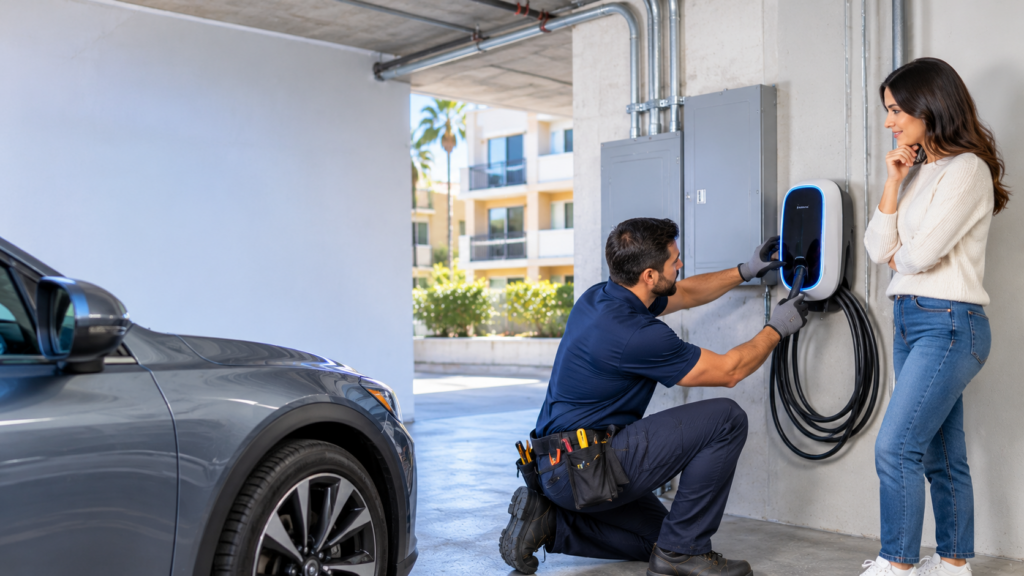
Installing an electric vehicle (EV) charger in a condominium in Los Angeles can be more complicated than installing one in a single-family home. Condo owners often share parking areas, electrical infrastructure, garages, and building facilities. Before installing a Level 2 EV charger, homeowners may need to coordinate with their Homeowners Association (HOA), evaluate electrical capacity, and obtain the required permits.
Understanding the EV charger installation in condo Los Angeles process can help you avoid unnecessary delays and prepare the right documentation before starting your project.
California law provides certain protections for condominium owners who want to install EV charging equipment. However, those protections do not eliminate reasonable HOA requirements, electrical safety standards, or local permitting rules.
This guide explains the HOA approval process, California EV charging laws, installation requirements, and important considerations for Los Angeles condo owners.
Can You Install an EV Charger in a Los Angeles Condo?
Yes. California law generally protects a homeowner’s ability to install an EV charging station within their individual unit or designated parking space in a common interest development.
Under California Civil Code Section 4745, HOA rules that effectively prohibit or unreasonably restrict EV charger installation or use are generally void and unenforceable.
This protection can apply to:
- Deeded parking spaces.
- Assigned parking spaces.
- Exclusive-use common-area parking spaces.
- Eligible installations within an owner’s individual unit.
However, the installation must still comply with applicable electrical codes, building requirements, health and safety standards, and reasonable HOA restrictions.
For example, an HOA may establish reasonable architectural requirements for conduit placement, equipment appearance, wiring routes, and installation methods, provided those restrictions do not significantly increase the installation cost or reduce the charger’s efficiency or performance.
Step 1: Review Your Condo’s HOA Rules
Before purchasing an EV charger, review your condominium’s governing documents and contact the HOA or property management company.
Ask about the association’s EV charging policy and whether it has an established architectural review process.
Important documents to review include:
- CC&Rs (Covenants, Conditions, and Restrictions).
- Architectural modification guidelines.
- Parking and garage rules.
- Electrical modification requirements.
- Insurance and contractor requirements.
- Existing EV charging policies.
You should also determine whether your parking space is deeded, assigned, or classified as exclusive-use common area.
This distinction matters because installation responsibilities and approval procedures can vary depending on where the charger and related equipment will be located.
Step 2: Submit a Written HOA Approval Request
If your installation requires HOA approval, submit a written application explaining the proposed work.
A complete application can help the association understand the project and review potential safety or property concerns.
Your application should ideally include:
- Proposed EV charger location.
- Charger make, model, and electrical specifications.
- Parking space identification.
- Electrical panel location.
- Proposed wiring and conduit route.
- Installation drawings or photographs.
- Licensed electrical contractor information.
- Insurance documentation, if requested.
For installations involving shared electrical infrastructure, provide additional information about the proposed electrical connection and how electricity usage will be measured and billed.
California Civil Code Section 4745 requires the HOA to process an EV charging application in the same manner as an architectural modification application. The association must provide approval or denial in writing.
The law generally provides a 60-day period for written denial after receiving the application. If the association does not deny it in writing within that period, the application is deemed approved, unless the delay results from a reasonable request for additional information.
Step 3: Understand Your Rights Under California HOA Law
California Civil Code Section 4745 protects eligible homeowners from unreasonable restrictions on EV charger installation.
This means an HOA generally cannot create rules that effectively prevent a homeowner from installing a qualifying charging station in their unit or designated parking space.
However, the association can enforce reasonable requirements related to safety, construction, and property protection.
For example, an HOA may reasonably require:
- A licensed electrical contractor.
- Compliance with architectural standards.
- Appropriate insurance coverage.
- Safe conduit and wiring installation.
- Protection of shared walls and building structures.
- Payment for installation and electricity usage.
For chargers installed in common areas or exclusive-use common areas, additional written commitments and insurance requirements apply.
The law was amended through SB 770, effective January 1, 2026, so homeowners should review the current version of Section 4745 rather than relying on older HOA policy summaries.
Step 4: Get an Electrical Assessment Before Installation
HOA approval is only one part of the process. Your condo’s electrical infrastructure must also be capable of supporting the charger.
A Level 2 EV charger typically requires a 240-volt electrical connection and a dedicated circuit.
A licensed electrical contractor should evaluate:
- Existing electrical panel capacity.
- Available circuit capacity.
- Distance between the panel and parking space.
- Conduit and wiring requirements.
- Building electrical service limitations.
- Potential electrical panel or service upgrades.
- Whether a separate meter is needed.
Some condominium buildings have centralized electrical rooms or shared utility infrastructure. In these situations, installing a charger may require coordination with building management, the utility provider, and the HOA.
Completing an electrical assessment early can help identify installation challenges before you commit to equipment or construction work.
Step 5: Confirm the EV Charger Permit Requirements in Los Angeles
HOA approval and city permitting are two separate processes.
For properties within the City of Los Angeles, the Los Angeles Department of Building and Safety (LADBS) handles applicable building and electrical permits.
A qualifying installation may be eligible for an express electrical permit. More complex installations, including certain multifamily projects, may require additional documentation or plan review.
Depending on the project, documents may include:
- Electrical plans.
- Charger specifications.
- Site and parking layout.
- Wiring and conduit details.
- Electrical load calculations.
- Accessibility information.
- Structural details where applicable.
For multifamily properties, accessibility requirements and the building’s electrical infrastructure can make the permitting process more involved than a typical single-family installation.
If the property is outside the City of Los Angeles, the appropriate city or county building department may handle the permit.
An important distinction: obtaining a city permit does not automatically provide permission to modify HOA-controlled property. Likewise, HOA approval does not replace the required electrical permits and inspections.
Step 6: Coordinate With LADWP if Necessary
Some Los Angeles condo projects may require coordination with the Los Angeles Department of Water and Power (LADWP).
This is especially important when the installation involves:
- A new electrical service.
- A panel or service upgrade.
- A separate time-of-use meter.
- Shared electrical infrastructure.
- Additional electrical capacity.
LADWP provides guidance for residential and multifamily EV charging projects and recommends preliminary assessments when electrical service capacity or installation conditions may create challenges.
For multifamily properties, commercial or multifamily charger projects may require additional plans and utility coordination.
Contacting the utility early can help identify potential service limitations before installation begins.
Step 7: Hire a Licensed Electrical Contractor
Once the project requirements are understood, work with a qualified electrical contractor experienced in EV charger installations.
The contractor should understand condominium electrical systems, applicable electrical codes, permit procedures, and the requirements of working in shared parking areas.
A professional installation generally involves:
- Confirming the approved installation location.
- Evaluating the electrical supply.
- Installing the required circuit and wiring.
- Installing the charger and associated equipment.
- Securing and protecting conduit.
- Completing required electrical inspections.
- Testing the charging equipment.
Using a licensed contractor is particularly important when the installation involves common-area property or shared electrical infrastructure.
Step 8: Complete the Required Inspection
After installation, arrange the required inspection through the applicable building department.
The inspector may review:
- Electrical wiring and connections.
- Breaker and circuit protection.
- Charger installation.
- Conduit and equipment placement.
- Compliance with applicable electrical codes.
- Other approved project requirements.
Do not begin using the installation until the required approvals and inspections have been completed.
Keep copies of the permit, inspection approval, equipment specifications, and contractor documentation for future reference.
Who Pays for EV Charger Installation in a Condo?
In many individual-owner installations, the homeowner is responsible for the cost of the charging equipment and associated electrical work.
Under California Civil Code Section 4745, when an owner installs a charger in common area or exclusive-use common area under the applicable approval process, the owner must agree to pay for:
- Charger equipment and installation.
- Electricity consumption.
- Maintenance and repairs.
- Damage caused by installation or removal.
- Restoration of the common area when the equipment is removed.
The owner also has insurance responsibilities under the statute.
The actual project cost depends on the charger, electrical panel capacity, wiring distance, building layout, and any additional construction or utility work.
What If Your HOA Denies Your EV Charger Request?
An HOA cannot simply reject a qualifying installation because it does not want EV chargers in the community.
California law generally prohibits unreasonable restrictions that significantly increase installation costs or reduce charging equipment performance.
If your application is denied:
- Request the HOA’s written explanation.
- Review the specific reason for denial.
- Compare the requested changes with California Civil Code Section 4745.
- Ask whether a reasonable alternative installation route is available.
- Consult a qualified professional or California HOA attorney if necessary.
If an HOA willfully violates Section 4745, the statute provides for actual damages and a civil penalty of up to $1,000. A prevailing homeowner in an enforcement action may also be entitled to reasonable attorney’s fees.
A property-specific legal review may be helpful if the association disputes your installation rights.
Common Mistakes to Avoid When Installing a Condo EV Charger
Condo owners can experience delays when they overlook HOA requirements or building electrical limitations.
Avoid these common mistakes:
- Purchasing a charger before checking the installation location.
- Assuming HOA approval and city permits are the same.
- Ignoring electrical panel capacity.
- Failing to identify whether the parking space is deeded or exclusive-use common area.
- Submitting incomplete HOA documentation.
- Hiring an unqualified installer.
- Overlooking shared electrical infrastructure.
- Starting construction before obtaining required approvals.
- Forgetting to arrange the final inspection.
Planning these steps in advance can make the installation process more organized and predictable.
Get Professional EV Charger Installation Help in Los Angeles
Installing an EV charger in a condominium requires careful coordination between the homeowner, HOA, electrical contractor, and local permitting authority.
Whether you own a deeded parking space, have an assigned garage space, or are planning a shared charging installation, understanding the electrical and approval requirements is essential.
ReVamp Energy provides residential and commercial EV charger installation and electrical services throughout Los Angeles and Southern California.
Our team can help evaluate your electrical setup, review installation requirements, and plan a charging solution based on your property’s electrical capacity and installation conditions.
Planning to install an EV charger in your Los Angeles condo? Contact ReVamp Energy to discuss your installation requirements and get started.