
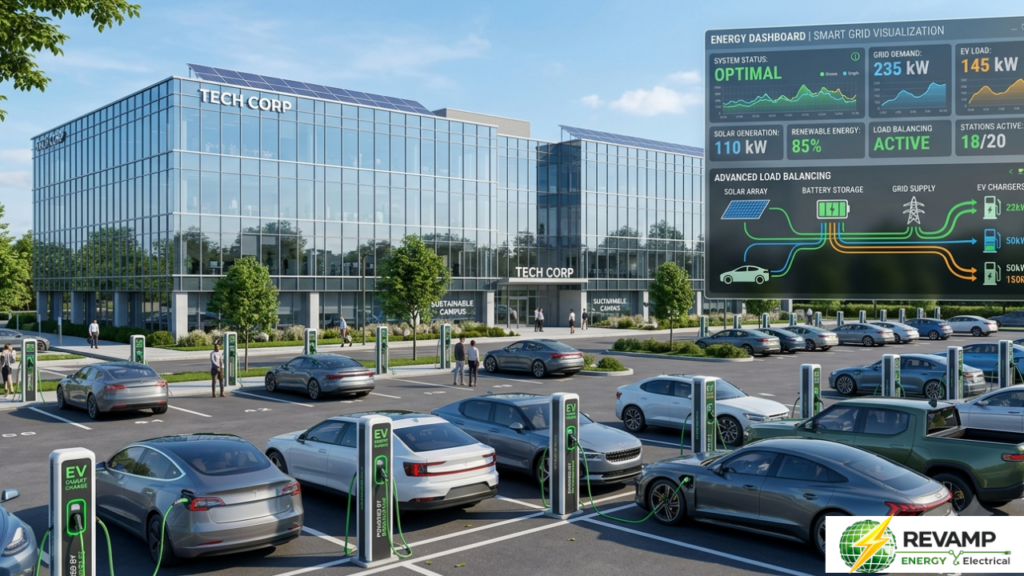
As electric vehicles become increasingly common across California, businesses are facing new challenges when it comes to managing energy consumption and charging infrastructure. Installing EV chargers is an important step toward supporting employees, customers, tenants, and fleet vehicles, but without proper planning, charging multiple vehicles can place significant strain on a property’s electrical system.
This is where Smart EV Charging Systems provide a major advantage.
Unlike traditional charging stations, smart charging technology allows businesses to monitor, control, and optimize charging operations while reducing energy costs and avoiding unnecessary electrical upgrades. For companies looking to expand their EV charging capabilities, smart charging has become one of the most effective tools for maximizing efficiency and controlling operating expenses.
What Are Smart EV Charging Systems?
Smart EV Charging Systems use advanced software and communication technology to manage how and when electric vehicles charge.
Rather than delivering maximum power to every charger at all times, smart charging systems intelligently distribute available power based on real-time demand and site conditions.
These systems help businesses:
- Optimize energy usage
- Balance electrical loads
- Prevent overloads
- Reduce operating costs
- Improve charging efficiency
- Support future expansion
As EV adoption continues to grow, intelligent energy management is becoming increasingly important for commercial properties.
How Smart Charging Works
Traditional charging systems typically operate at full power whenever a vehicle is connected.
While this approach may seem simple, it can create challenges when multiple vehicles charge simultaneously.
Smart EV Charging Systems continuously monitor:
- Electrical demand
- Available capacity
- Charging schedules
- Vehicle charging requirements
- Site energy consumption
The system then automatically adjusts charging output to maximize efficiency while protecting the property’s electrical infrastructure.
This process is often referred to as load management.
Understanding EV Load Management
One of the most valuable features of Smart EV Charging Systems is load management.
Load management allows multiple charging stations to share available electrical capacity without exceeding system limits.
For example, a business may have:
- 10 charging stations
- Limited electrical capacity
- Multiple vehicles charging at once
Instead of requiring expensive service upgrades, smart software distributes power where it is needed most.
Benefits include:
- Reduced peak demand
- Improved charger utilization
- Lower infrastructure costs
- Better energy efficiency
For many businesses, load management eliminates the need for costly electrical upgrades.
Reducing Peak Demand Charges
Commercial electricity bills often include demand charges based on peak energy consumption.
When several EV chargers operate simultaneously at full capacity, demand charges can increase significantly.
Smart EV Charging Systems help reduce these costs by:
- Staggering charging sessions
- Limiting charging during peak periods
- Balancing charger output
- Prioritizing energy usage
Reducing peak demand can result in substantial long-term savings for commercial properties.
Supporting Multiple Chargers Without Major Upgrades
Many business owners assume that adding additional EV chargers automatically requires expensive electrical upgrades.
In many cases, smart charging technology can help maximize existing electrical capacity.
By intelligently managing power distribution, businesses can often:
- Install more chargers
- Delay infrastructure upgrades
- Improve charging availability
- Reduce installation costs
This flexibility makes expansion more affordable as EV adoption grows.
Scheduling Charging for Lower Energy Costs
Electricity rates often vary throughout the day.
Smart charging systems can automatically schedule charging during lower-cost periods.
Benefits include:
- Reduced utility expenses
- Better energy planning
- Improved cost control
- Enhanced operational efficiency
Businesses that charge fleet vehicles overnight often benefit significantly from scheduled charging strategies.
Real-Time Monitoring and Reporting
Modern Smart EV Charging Systems provide detailed reporting tools that help businesses understand charging activity.
Reports may include:
- Energy consumption
- Charger usage
- Charging duration
- Peak demand trends
- Cost tracking
Access to this information allows property owners and facility managers to make informed decisions regarding future charging infrastructure investments.
Improving Employee and Customer Experience
Convenient EV charging can be a valuable amenity for employees and customers.
Smart charging systems help improve user experience by providing:
- Reliable charging access
- Better charger availability
- Reduced wait times
- Automated charging management
As electric vehicle ownership increases, these benefits can contribute to higher customer satisfaction and employee retention.
Smart Charging for Commercial Fleets
Fleet operators face unique charging challenges.
Vehicles often require predictable charging schedules while minimizing operating costs.
Smart EV Charging Systems support fleet operations by:
- Prioritizing vehicle charging
- Managing overnight charging
- Reducing peak demand
- Maximizing available electrical capacity
For businesses transitioning to electric fleets, intelligent charging management is often essential.
Integrating Smart Charging with Solar Energy
Many businesses are combining EV charging infrastructure with solar energy systems.
When integrated properly, solar power can help offset charging-related energy consumption.
Benefits include:
- Lower electricity costs
- Increased renewable energy usage
- Better energy independence
- Improved sustainability performance
Smart charging software can help coordinate charging activity with solar production to maximize efficiency.
Battery Storage and Smart Charging
Battery storage systems can further enhance EV charging performance.
When paired with Smart EV Charging Systems, batteries can help:
- Reduce peak demand charges
- Store excess energy
- Support charging during high-demand periods
- Improve overall energy management
Businesses investing in long-term energy strategies often combine solar, battery storage, and smart charging technologies.
Future-Proofing Your Property
EV adoption is expected to continue growing over the coming years.
Businesses that plan ahead are often better positioned to support future charging demands.
Smart EV Charging Systems provide flexibility that allows businesses to:
- Add chargers as demand increases
- Manage energy more effectively
- Control infrastructure costs
- Adapt to future technology
Investing in scalable charging solutions today can help avoid costly modifications later.
Common Mistakes Businesses Make
Installing Chargers Without Load Analysis
Understanding available electrical capacity is essential before installation.
Ignoring Future Growth
Many businesses underestimate future charging demand.
Focusing Only on Upfront Costs
The lowest-cost charging solution may not provide the best long-term value.
Overlooking Smart Features
Advanced energy management capabilities often produce significant savings over time.
Why Businesses Choose ReVamp Energy Solutions
At ReVamp Energy Solutions, we help businesses design and install Smart EV Charging Systems that support long-term growth while controlling energy costs.
Our services include:
- Commercial EV charger installation
- Smart charging solutions
- EV load management systems
- Electrical panel upgrades
- Energy infrastructure planning
- Solar integration
- Battery storage solutions
We work closely with business owners to create customized charging solutions that maximize efficiency and future scalability.
Conclusion
Smart EV Charging Systems are transforming the way businesses manage electric vehicle charging infrastructure.
By intelligently controlling charging loads, reducing peak demand, optimizing energy consumption, and supporting future expansion, smart charging technology provides significant advantages over traditional charging systems.
Whether you’re installing chargers for employees, customers, tenants, or fleet vehicles, investing in intelligent charging solutions can help reduce costs, improve efficiency, and prepare your property for the future of transportation.
FAQs
What are Smart EV Charging Systems?
Smart EV Charging Systems use software and communication technology to manage charging activity and optimize energy usage.
How do smart chargers reduce energy costs?
They help manage electrical demand, reduce peak usage, and schedule charging during lower-cost periods.
Can smart charging prevent electrical overloads?
Yes. Load management features automatically balance charging activity to stay within available electrical capacity.
Do smart charging systems work with solar panels?
Yes. Smart chargers can be integrated with solar energy systems to improve overall energy efficiency.
Are Smart EV Charging Systems suitable for commercial properties?
Absolutely. They are widely used in offices, retail centers, apartment complexes, hotels, and fleet charging facilities.