
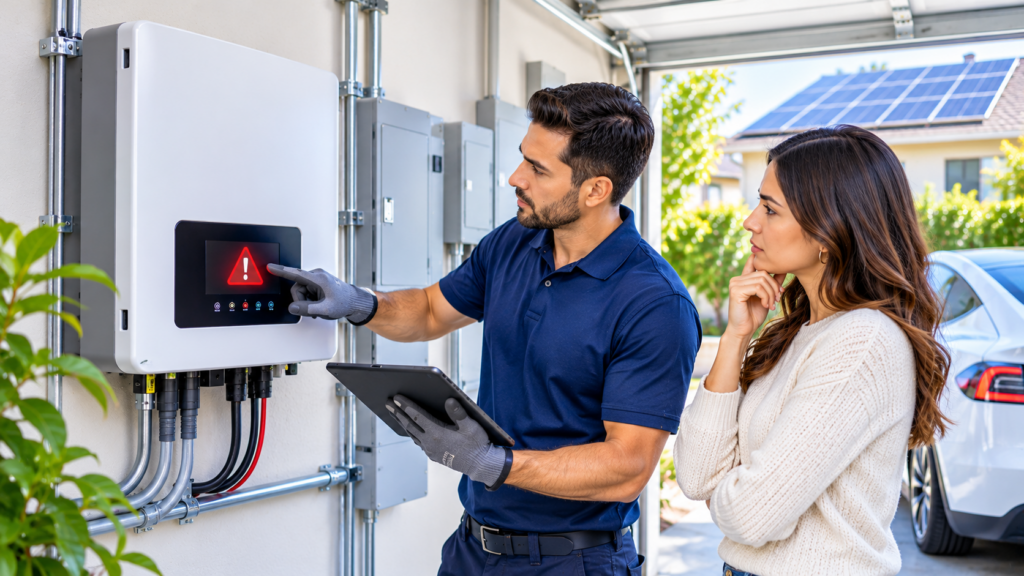
Your solar panels are installed, the sun is shining, but your electricity production has suddenly dropped—or your inverter has stopped working completely. What should you do?
If your solar inverter is not working, the problem could be something simple, such as a temporary grid interruption or monitoring connection issue. However, it could also indicate an overheating problem, electrical fault, damaged wiring, or an internal inverter failure.
A solar inverter is one of the most important components of your solar energy system. It converts the DC electricity generated by your solar panels into AC electricity that your home or business can use. When it stops operating correctly, your solar system may produce less electricity or stop generating power altogether.
The good news is that not every inverter warning means you need a replacement. Understanding the symptoms can help you identify the possible cause and know when professional service is necessary.
In this guide, we explain 7 common solar inverter problems and their solutions, including what you can safely check before contacting a qualified solar technician.
How to Know If Your Solar Inverter Is Not Working
Before assuming your inverter has failed, check what your system is actually reporting.
Common warning signs include:
- The inverter display is blank during daylight hours.
- The inverter shows an error or fault message.
- Solar production suddenly drops to zero.
- The inverter repeatedly shuts down or restarts.
- The system produces less electricity than usual.
- The inverter makes unusual buzzing or clicking sounds.
- Your solar monitoring app stops updating production data.
Important: Many grid-connected solar inverters automatically enter night mode after sunset. A blank screen or inactive display at night does not necessarily indicate a problem. Check the system during daylight before assuming it has failed.
7 Common Solar Inverter Problems and Solutions
1. Solar Inverter Not Turning On
One of the most common complaints homeowners experience is an inverter that will not turn on.
You may notice that the display is completely blank, the indicator lights are off, or the system is not showing any production during daylight hours.
Possible causes:
- An AC breaker has tripped.
- A solar system isolator or disconnect has been switched off.
- A grid interruption has affected system operation.
- An internal power supply component has failed.
- The inverter has developed an electrical fault.
What you can do:
First, check whether your home has electricity and whether your utility grid is operating normally. Look at the inverter display and monitoring application for warning messages.
You can also visually inspect accessible breaker handles and check whether an indicator shows that a breaker has tripped. Only operate clearly identified user-accessible controls according to the manufacturer’s instructions. Do not remove electrical panel covers or open the inverter.
If the inverter remains off during daylight or repeatedly shuts down, arrange a professional inspection. A qualified technician can test the AC and DC connections, verify the power supply, and determine whether the inverter requires repair or replacement.
2. Solar Inverter Showing an Error Code
An inverter error code is an important warning that something may be preventing your solar system from operating normally.
Different inverter manufacturers use different error codes, so the same number can mean different things on different models.
Some common fault categories include:
| Error message | Possible meaning |
|---|---|
| Grid Fault | Utility voltage or frequency issue |
| Overtemperature | Inverter operating too hot |
| DC Fault | Problem with solar panel input |
| Isolation Fault | Possible insulation or ground fault |
| Overvoltage | Voltage outside the permitted range |
| Communication Error | Monitoring or data connection issue |
How to solve it:
- Record the complete error code and message.
- Check your inverter manufacturer’s documentation.
- Review whether the warning is temporary or keeps returning.
- Contact a qualified solar technician if the system is not producing power or the warning persists.
Never attempt to bypass an inverter safety warning. Some faults indicate potentially dangerous electrical conditions and require professional testing.
3. Solar Inverter Not Producing Power
Your inverter may appear to be switched on, but your solar monitoring application shows little or no electricity generation.
This problem can be confusing because the inverter may not display an obvious failure.
Possible causes:
- Heavy cloud cover or insufficient sunlight.
- Dirt, debris, or shading affecting the solar panels.
- A problem with one or more solar panel strings.
- An AC grid connection issue.
- An inverter protection shutdown.
- A faulty MPPT tracking component.
Possible solutions:
Start by checking the weather and comparing your current production with previous days under similar sunlight conditions.
Look for visible shading from trees, nearby buildings, or new rooftop equipment. If the panels appear dirty, arrange appropriate professional cleaning when necessary.
If the weather is clear and production remains unusually low, a technician should inspect the inverter’s production readings, panel strings, and electrical connections.
A system that is switched on is not necessarily generating electricity. Actual production readings are what matter.
4. Solar Inverter Overheating and Shutting Down
Solar inverters generate heat while converting electricity. However, excessive heat can cause the equipment to reduce its output or shut down to protect internal components.
This issue can be more noticeable during hot summer conditions or when the inverter is installed in an enclosed location.
Common reasons include:
- Insufficient ventilation around the inverter.
- Direct exposure to intense sunlight.
- Dust blocking ventilation openings.
- A cooling fan malfunction.
- Excessively high surrounding temperatures.
How to solve it:
Check whether the inverter’s external ventilation area is clear. Remove objects that block airflow and keep the surrounding space free from unnecessary storage.
If the manufacturer permits external cleaning, follow its instructions without opening the unit.
If the overheating warning continues, contact a qualified technician. The cooling system, internal temperature sensors, and installation location may need inspection.
Do not open the inverter or attempt to repair its internal cooling components yourself.
5. Solar Inverter Keeps Tripping or Restarting
Does your inverter start normally but shut down after a few minutes? Does it repeatedly restart throughout the day?
Frequent shutdowns can indicate that the inverter is detecting an operating condition outside its permitted limits.
Possible causes:
- Unstable utility grid voltage.
- Grid frequency fluctuations.
- Loose or damaged electrical connections.
- Excessive inverter temperature.
- DC-side electrical faults.
- Internal component failure.
What should you do?
Check whether the inverter displays a grid fault, temperature warning, or another specific error before shutting down.
If the issue occurs repeatedly during peak sunlight hours, record the time and any displayed warning. This information can help a technician identify whether the issue is related to grid conditions, temperature, or solar input.
Avoid repeatedly resetting the inverter without identifying the underlying cause. Frequent shutdowns should be professionally diagnosed.
6. Solar Inverter App Not Showing Production Data
Sometimes homeowners assume their solar inverter has stopped working because their monitoring application shows zero production or displays the system as offline.
However, the inverter and its monitoring connection are two separate functions.
Your inverter may still be generating electricity even when the app cannot communicate with it.
Possible causes:
- Home Wi-Fi has stopped working.
- The router password has changed.
- The inverter’s monitoring device has lost connectivity.
- A data logger or communication module has failed.
- The monitoring platform is experiencing an outage.
How to troubleshoot it:
- Check whether your home internet connection is working.
- Confirm that the inverter’s monitoring device has power.
- Check the manufacturer’s application for connection warnings.
- Review the inverter’s actual production display, if available.
- Follow the manufacturer’s instructions to reconnect monitoring.
If the app remains offline while the inverter appears to be operating normally, ask your installer to inspect the communication equipment.
Do not assume that a monitoring problem means the solar panels have stopped generating electricity.
7. Solar Inverter Making Unusual Noise
A solar inverter may produce a low humming sound during normal operation. Cooling fans and electrical components can create some operating noise.
However, loud buzzing, grinding, repeated clicking, or unusual sounds that were not present before may indicate a problem.
Possible reasons:
- Cooling fan malfunction.
- Loose internal components.
- Electrical component deterioration.
- Excessive vibration.
- A developing internal fault.
What can you do?
Listen to the sound from a safe distance and check whether the inverter is also showing an error or overheating warning.
If the noise is unusually loud, becomes worse, or occurs alongside a burning smell, smoke, or visible damage, keep away from the equipment and arrange urgent professional assistance. If there is smoke or fire, contact emergency services.
Never open the inverter to investigate the noise yourself.
Solar Inverter Troubleshooting Checklist
Before contacting a solar service professional, collect the following information:
| What to check | Why it matters |
|---|---|
| Inverter brand and model | Identifies the correct troubleshooting instructions |
| Error code or warning | Helps identify the fault category |
| Current production reading | Shows whether electricity is being generated |
| Time the problem started | Helps identify recurring patterns |
| Recent power outages | May explain grid-related faults |
| Monitoring app status | Separates production problems from communication issues |
| Recent maintenance or electrical work | Helps identify possible installation-related issues |
This information can make the inspection process more efficient and help your technician understand the problem before arriving.
When Should You Call a Professional for Solar Inverter Repair?
Some basic observations can be completed by a homeowner, but solar inverter repair is not a DIY electrical project.
Contact a qualified solar or electrical professional if:
- Your inverter remains off during daylight.
- Production stays at zero despite good sunlight.
- An electrical or isolation fault appears.
- Your inverter repeatedly trips or restarts.
- Overheating warnings continue.
- You notice damaged cables, burning smells, or unusual noises.
- Your solar system’s output has dropped significantly without an obvious explanation.
Solar systems contain potentially dangerous DC and AC electrical circuits. Never open the inverter, touch internal terminals, disconnect solar wiring, or bypass protective devices.
A professional inspection can determine whether the problem is related to the inverter, solar panels, electrical connections, utility grid, or monitoring equipment.
Should You Repair or Replace a Solar Inverter?
Not every inverter problem requires a complete replacement.
The right decision depends on the equipment’s age, warranty status, fault type, availability of replacement components, and overall repair cost.
Repair may be appropriate when:
- The fault is related to a serviceable component.
- The inverter is still within its warranty period.
- The equipment is otherwise operating reliably.
- The repair cost is reasonable compared with replacement.
Replacement may be worth considering when:
- The inverter has suffered major internal damage.
- Repairs are becoming frequent.
- Replacement components are unavailable.
- The inverter is near the end of its expected service life.
- A newer system would provide a more suitable solution.
Before replacing an inverter, have the complete solar system inspected. Installing a new inverter without addressing an underlying panel, wiring, or grid issue may not solve the original problem.
How to Prevent Solar Inverter Problems
Regular maintenance can help identify developing issues before they cause major production losses.
Here are practical ways to protect your solar investment:
- Schedule professional inspections: Have your solar system checked periodically according to the manufacturer’s maintenance recommendations.
- Maintain proper ventilation: Keep the inverter’s surrounding area clear.
- Monitor solar production: Compare monthly and daily production patterns to identify unusual changes.
- Check for visible damage: Look for external signs of cable damage, water intrusion, or physical deterioration without touching electrical components.
- Keep maintenance records: Save error messages, inspection reports, and repair history.
- Understand your inverter warranty: Know what parts, labor, and service conditions are covered.
Preventive maintenance is often easier and less expensive than waiting until an inverter failure interrupts your solar production.
Need Professional Solar Inverter Troubleshooting in Los Angeles?
If your solar inverter is not working, producing less electricity, or repeatedly displaying fault messages, identifying the actual cause is the first step toward restoring your system.
At ReVamp Energy, we provide electrical and renewable energy services for residential and commercial properties across Los Angeles and Southern California.
Our team can help assess solar system performance, investigate electrical issues, and determine the appropriate next steps for your equipment.
Whether you are experiencing an inverter fault, unexpected production drop, or a recurring system shutdown, a professional evaluation can help you understand the problem before investing in unnecessary equipment replacement.
Get Your Free Energy Consultation
Visit ReVamp Energy to discuss your solar system and electrical service needs.
Frequently Asked Questions About Solar Inverter Problems
Why is my solar inverter not working during the day?
Possible reasons include a tripped breaker, grid interruption, DC input fault, overheating, or internal inverter failure. Check the display for an error message and arrange professional inspection if production does not resume.
Why is my solar inverter showing zero output?
Zero output can result from insufficient sunlight, grid problems, panel-side faults, inverter protection mode, or an internal equipment issue. Compare production readings with the weather and previous days before diagnosing the problem.
Can a solar inverter stop working because of extreme heat?
Yes. Excessive temperature can cause some inverters to reduce output or shut down temporarily to protect internal components. Poor ventilation and cooling-system problems can make overheating worse.
How do I reset a solar inverter?
Reset procedures differ by manufacturer and model. Follow the manufacturer’s official shutdown and restart instructions or contact your installer. Do not disconnect DC wiring or operate electrical disconnects without understanding the required safety procedure.
Does a faulty solar inverter affect the entire solar system?
In many systems, an inverter failure can stop or significantly reduce electricity conversion from the connected solar panels. The exact impact depends on the system design, including whether it uses microinverters or a central string inverter.
How long does a solar inverter last?
The expected service life depends on the inverter type, manufacturer, operating environment, installation quality, and maintenance. Check the manufacturer’s warranty and service documentation for your specific model.
Is it better to repair or replace a solar inverter?
It depends on the fault, repair cost, warranty, equipment age, and availability of parts. A professional diagnosis should come before deciding to replace the inverter.
Can solar panels work if the inverter stops working?
Solar panels can still receive sunlight and generate DC electricity, but a grid-connected system generally needs its inverter to convert that electricity into usable AC power. Some systems have separate backup or microinverter arrangements, so the exact behavior depends on the installation.
Final Takeaway: A solar inverter problem does not automatically mean your entire solar system needs replacement. Identifying the warning signs, checking production data, and arranging a professional inspection can help restore performance and protect your investment.