
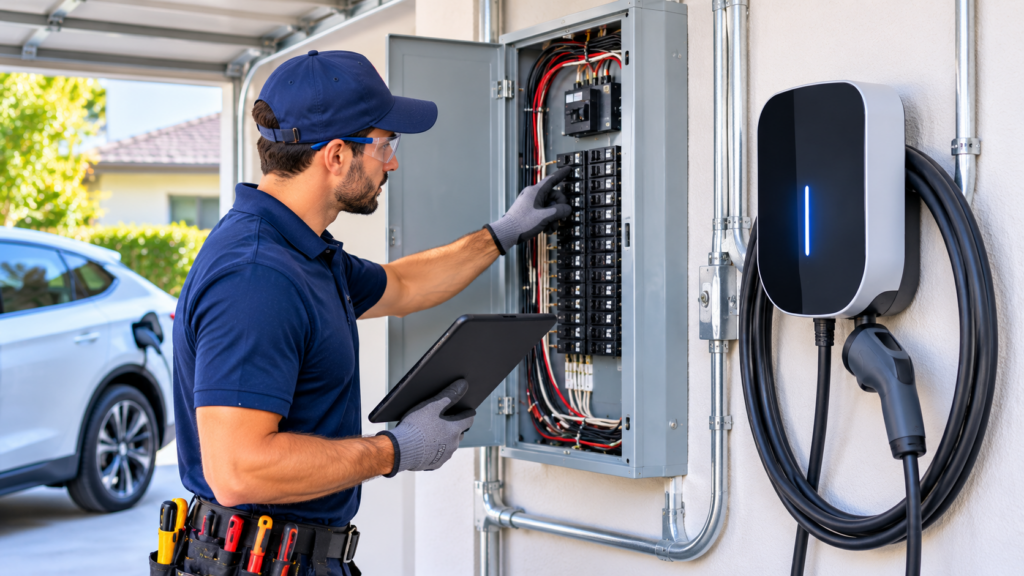
Thinking about installing a Level 2 EV charger at home but worried that your electrical panel is too old? Many homeowners in Los Angeles and across California have 100-amp or 125-amp electrical panels and assume they must replace the entire panel before installing an EV charger.
The good news is that an older electrical panel can sometimes support a Level 2 EV charger without a complete upgrade. However, the answer depends on your electrical service capacity, existing household demand, panel condition, and charger amperage.
In this guide, we explain how to determine whether your existing panel can support EV charging, when an upgrade is necessary, and what options California homeowners should consider.
Can You Install a Level 2 EV Charger on an Old Electrical Panel?
Yes. The age of your electrical panel alone does not determine whether it can support a Level 2 EV charger.
An electrician needs to evaluate:
- Main electrical service capacity.
- Existing household electrical demand.
- Available breaker spaces.
- Condition of the panel and breakers.
- Existing wiring and grounding.
- EV charger’s voltage and amperage requirements.
For example, a home with a 100-amp panel and gas appliances may have enough available capacity for a lower-amperage Level 2 charger. However, a home with electric heating, an electric dryer, an electric water heater, and central air conditioning may have limited capacity.
A professional electrical load calculation is necessary before installation.
What Electrical Panel Size Do You Need for a Level 2 EV Charger?
Most residential Level 2 EV chargers use a 208V or 240V electrical supply.
The circuit size depends on the charger’s maximum charging current.
| Charger output | Typical circuit size |
|---|---|
| 16 amps | 20-amp circuit |
| 24 amps | 30-amp circuit |
| 32 amps | 40-amp circuit |
| 40 amps | 50-amp circuit |
| 48 amps | 60-amp circuit |
EV charging is generally considered a continuous electrical load. Therefore, the circuit normally needs to be sized at 125% of the charger’s maximum continuous current.
Actual breaker and wire sizing must follow applicable electrical codes and equipment instructions.
Can a 100-Amp Electrical Panel Support a Level 2 EV Charger?
A 100-amp electrical panel may support a Level 2 EV charger, but it depends on the home’s existing electrical loads.
Consider a home with:
- A 100-amp electrical service.
- Gas cooking and water heating.
- Standard household appliances.
- Moderate air-conditioning usage.
- A proposed 24-amp or 32-amp EV charger.
Depending on the load calculation, installation may be possible without upgrading the main panel.
However, a home with several high-power electric appliances may not have enough available capacity.
The important factor is the calculated electrical demand of the entire property, not simply the panel’s amp rating.
Can a 125-Amp Electrical Panel Support an EV Charger?
A 125-amp panel may offer more flexibility than a 100-amp service, but it still requires an electrical assessment.
An electrician should evaluate existing loads, available capacity, panel condition, and the proposed charging amperage.
Some 125-amp systems can accommodate a Level 2 charger without a complete service upgrade. Others may require a lower charging setting or an approved load management system.
What If Your Old Electrical Panel Does Not Have Enough Capacity?
If your existing panel cannot safely support the additional charging load, you may have several options.
1. Install a Lower-Amperage EV Charger
Some Level 2 chargers allow the charging current to be adjusted.
For example, a compatible charger may operate at 24 or 32 amps instead of 48 amps.
Lower charging amperage reduces the electrical demand and may make installation possible without a full panel upgrade.
The circuit, wiring, charger, and load calculation must all support the selected setting.
2. Use a Smart EV Load Management System
A smart load management system monitors household electrical demand and adjusts EV charging power when other appliances are operating.
For example, when your air conditioner or electric dryer starts, the system can reduce EV charging power. When household demand decreases, charging power can increase again.
This can help avoid unnecessary panel upgrades when the equipment and installation meet applicable safety and code requirements.
3. Upgrade the Electrical Panel
If your existing panel cannot safely accommodate the additional load, an electrical panel upgrade may be necessary.
An upgrade may be appropriate when:
- The electrical service has insufficient capacity.
- The panel is damaged or deteriorated.
- Existing equipment is unsuitable.
- Load management is not a practical solution.
- You are planning additional electrical upgrades.
The project may involve a new panel, breakers, wiring, permits, inspections, and utility coordination.
4. Install a Subpanel When Appropriate
A subpanel can provide additional circuit spaces and improve electrical circuit organization.
However, a subpanel does not create additional electrical capacity. It still depends on the available capacity of the main service.
A qualified electrician must determine whether this option is appropriate.
5 Warning Signs Your Old Electrical Panel May Need an Upgrade
Before installing an EV charger, consider these warning signs.
1. Breakers Frequently Trip
Repeated breaker trips may indicate excessive electrical demand or another electrical problem. Investigate the cause before adding a new charging circuit.
2. Your Panel Is Damaged
Corrosion, overheating marks, damaged components, or unusual odors require professional inspection.
3. No Available Breaker Space
A Level 2 charger generally needs a dedicated branch circuit. An electrician must evaluate suitable options if the panel has no available space.
4. Your Home Uses Multiple High-Power Appliances
Electric HVAC systems, water heaters, dryers, and cooking equipment can use significant electrical capacity.
5. Your Panel Is an Older or Obsolete Model
Some older panels may have safety, compatibility, or equipment-condition concerns. Have the manufacturer and model evaluated before installation.
Does California Require a Panel Upgrade for Level 2 EV Charger Installation?
California does not have a blanket requirement that every homeowner must replace an old electrical panel before installing a Level 2 EV charger.
Installations must comply with applicable California Electrical Code requirements, local permitting rules, and equipment manufacturer instructions.
In Los Angeles, homeowners should confirm the applicable requirements with the local building and safety authority.
A qualified electrical contractor can help determine:
- Whether the existing panel has enough capacity.
- Whether a dedicated 240V circuit can be installed.
- Whether load management is appropriate.
- Whether a panel or service upgrade is necessary.
- Which permits and inspections apply.
How Much Does It Cost to Install a Level 2 EV Charger in California?
The total installation cost depends on the charger, distance from the electrical panel, wiring requirements, panel condition, and any required upgrades.
Common project costs include:
| Installation type | Cost considerations |
|---|---|
| Basic charger installation | Short wiring run and sufficient panel capacity |
| Long-distance wiring | Additional conduit and materials |
| Panel modification | Breakers and electrical work |
| Load management | Compatible monitoring and control equipment |
| Panel upgrade | New panel, breakers, and labor |
| Service upgrade | Utility coordination and service equipment |
A straightforward installation can be much less expensive than a project requiring a complete electrical service upgrade.
For an accurate estimate, have your panel and proposed charger location evaluated first.
What Should an Electrician Check Before Installing Your EV Charger?
A professional electrical assessment should include:
- Panel inspection to check its rating, condition, and breaker compatibility.
- Load calculation to evaluate existing household demand.
- Charger selection based on voltage and amperage.
- Circuit planning for the correct breaker and conductors.
- Installation location and wiring distance.
- Grounding, protection, and applicable code requirements.
- Permit and inspection requirements.
This process helps prevent overloaded equipment and unnecessary electrical upgrades.
Need Level 2 EV Charger Installation in Los Angeles?
An older electrical panel does not automatically mean you cannot install a Level 2 EV charger.
The right solution depends on your home’s electrical capacity, existing appliances, charger requirements, and panel condition.
At ReVamp Energy, we provide residential and commercial electrical services across Los Angeles and Southern California.
Our team can help evaluate your existing electrical panel, assess the requirements for a dedicated EV charging circuit, and determine whether your property needs a panel upgrade or another suitable solution.
Whether you are installing your first home EV charger or upgrading an older electrical system, getting the electrical assessment right is the first step.
Get Your Free Energy Consultation
Visit https://revampenergy.com/ to discuss your EV charger installation and electrical panel requirements.
Frequently Asked Questions
Can a 30-year-old electrical panel support a Level 2 EV charger?
Yes, potentially. Its condition, electrical rating, available capacity, and compliance with applicable requirements must be evaluated.
Can I install a Level 2 EV charger on a 100-amp panel?
Possibly. A 100-amp panel may support a lower-amperage Level 2 charger if the required load calculation confirms sufficient capacity.
Does a 200-amp panel guarantee EV charger installation?
No. A 200-amp panel can still have insufficient available capacity if the home already has substantial electrical demand.
Can I install an EV charger without upgrading my panel?
Yes, in some cases. A lower-amperage charger or approved load management system may make installation possible without a complete panel upgrade.
Does a Level 2 EV charger need its own breaker?
Residential Level 2 chargers generally require a properly sized dedicated branch circuit in accordance with equipment instructions and applicable electrical code.
Is a subpanel enough for EV charger installation?
A subpanel provides additional circuit spaces but does not increase the capacity of the main electrical service.
Do I need a permit to install a Level 2 EV charger in California?
Requirements depend on the local jurisdiction and project scope. Check applicable permitting requirements before installation.
Final Takeaway: An old electrical panel can sometimes support a Level 2 EV charger without a complete upgrade. The deciding factors are electrical capacity, existing household demand, circuit requirements, and safe installation—not simply the panel’s age.